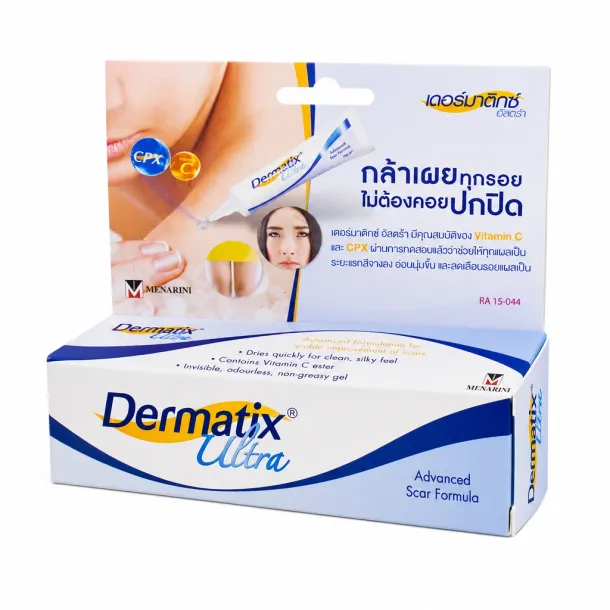
Dermatix Ultra Gel — clear silicone gel that fades hypertrophic scars and keloids
💊 Active ingredient: Polysiloxane (silicone polymer)
⏱️ How to use: Apply a thin layer over the scar twice daily
🍽️ Condition: Apply only once fully closed — never on open skin
📦 Pack size: 5g and 15g tubes
⚡ Key benefit: Dries in 4-5 minutes, non-sticky, make-up can go over it
🌡️ Storage: Below 30°C, keep the cap tightly closed
Done — we will alert you on LINE when this item is back.
Remind me to reorder
Remind me every
First reminder 20 Oct 2026 · on LINE
Shipping
Discreet shipping within Thailand — packaging does not identify the product. Customers can review shipping and return conditions per our store policy. Contact our team for any questions.
What is Dermatix Ultra Gel?
Dermatix Ultra Gel is a clear topical silicone gel with polysiloxane as its active ingredient. It works by forming a thin protective film over the scar, sealing in moisture and helping regulate the excess collagen production behind hypertrophic scars and keloids. With consistent use, scars gradually soften, flatten, and fade in colour. It comes in two sizes: 5g and 15g tubes for different scar areas.
🛒 Available in 5g and 15g tubes · 100% authentic · 24-hour dispatch from Intimo Life — consult a doctor or pharmacist before use.
Product Description
Silicone gel like Dermatix Ultra Gel works differently from ordinary scar creams: instead of absorbing into the skin, it forms a thin occlusive film over the scar. This film traps moisture in the outer skin layer and helps down-regulate the fibroblast activity that produces excess collagen — the process behind hypertrophic scars and keloids. With regular use, raised scars gradually flatten and soften. This differs from Hirudoid, already sold at Intimo Life, which uses a Mucopolysaccharide Polysulphate (MPS) formula that boosts local blood circulation — better suited to bruising and blood pooling than raised scar tissue.
📊 A systematic review of randomised controlled trials found that at least 2 months of continuous topical silicone gel use significantly reduced scar thickness, pigmentation, and height compared with no treatment.
⚠️ Warning: Do not apply to open wounds or infected skin. Stop use and consult a pharmacist if irritation occurs.
Medically reviewed by
Supatcheree A., Pharmacist | Sources: NHS, AAD, StatPearls, PMC
Last reviewed: 2026-09-20
About Dermatix Ultra Gel
What Is Dermatix Ultra Gel?
Dermatix Ultra Gel is a clear, topical silicone gel with polysiloxane, a long-chain silicone polymer, as its active ingredient. Once applied, it dries into an almost invisible thin film that sits over the scar. This film seals the skin surface and reduces water loss, keeping the scarred area hydrated. That hydrated environment helps regulate fibroblast activity so it does not overproduce collagen — the main process behind raised, hypertrophic scars. With continued use, scars gradually soften, flatten, and fade in colour. The gel itself is colourless and virtually odourless, so it fits easily into a daily long-term routine.
What Does Dermatix Ultra Gel Treat?
Dermatix Ultra Gel is used for hypertrophic scars and keloids caused by surgery, burns, acne, ear piercings, or accidental injuries. It works on both fresh scars that have just closed and older, thickened scars that have been raised for years. Regular use helps reduce raised thickness, redness, and the itching or tightness that often comes with hypertrophic scarring, gradually smoothing the scar surface closer to normal skin texture. It also suits scars left behind after a caesarean section, appendix surgery, or other minor procedures.
How to Apply Dermatix Ultra Gel for Best Results
Clean and fully dry the scarred area before every application. Squeeze out a small amount and spread it thinly over the entire scar to form a film, twice daily — morning and before bed. Let it dry for 4-5 minutes into a film before dressing or applying make-up. Continuous use for at least 2-3 months is needed to see clear improvement; larger or older scars may take longer. The 5g tube suits one or two small scars, while the 15g tube suits wider areas or longer-term use. There is no need to cover the area with a dressing afterwards unless a doctor advises otherwise.
Side Effects of Dermatix Ultra Gel
Side effects from Dermatix Ultra Gel are uncommon and usually mild — occasional itching, redness, or slight irritation at the application site, which typically resolves once use stops. If swelling, burning, or a spreading rash occurs, stop use immediately, rinse the area with clean water, and consult a pharmacist or doctor before reapplying. Anyone with sensitive skin may want to test a small patch of normal skin for a day or two first to check for a reaction.
Precautions and Contraindications for Dermatix Ultra Gel
Do not apply to open wounds that have not fully closed, infected skin, pus, or inflamed injuries. Avoid the eye area and mucous membranes, since the gel is not designed for those surfaces. Anyone with a history of silicone sensitivity should patch-test a small area first. For very new scars that are still swollen and red, check with a doctor before starting. Keep the treated area out of strong sun exposure, since it is more prone to dark discolouration during treatment. If it accidentally gets into the eyes, rinse immediately with plenty of clean water.
Dermatix Ultra Gel vs Other Scar Gels
Hirudoid Cream (Mucopolysaccharide Polysulphate) uses an MPS formula that boosts local blood circulation, making it better suited to bruising and blood pooling than raised scars. The cream absorbs into the skin rather than leaving a surface film the way Dermatix Ultra does. Hiruscar Ultra Scar Care Gel (Allium Cepa) is also a gel, built around onion extract for its anti-inflammatory and tissue-remodelling effect, a different mechanism from pure silicone occlusion with no plant extract involved. In short: choose Dermatix Ultra Gel for a true silicone-gel approach to hypertrophic scars and keloids, Hirudoid for bruising, and Hiruscar Ultra for a natural-extract scar gel.
Can Dermatix Ultra Gel Be Used with Other Products?
Dermatix Ultra Gel can be used alongside sunscreen as usual — let the gel dry fully first, then apply sunscreen on top. Avoid layering another scar treatment product over the same area at the same time, since it may reduce how well the silicone film performs. Leave at least a one-day gap if switching to a different scar product. Regular make-up can be applied on top once the film has fully set.
How Fast Does Dermatix Ultra Gel Work?
Silicone gel does not work instantly — it needs consistent daily use. Most people notice the scar softening and fading within 4-8 weeks, with clearer results after a full 2-3 month course. Fresh scars tend to respond faster than scars that have been raised for years, which may need more than 3 months of continuous use before a clear change appears. Applying it consistently every day matters more for speed of results than how much gel is used per application.
Where to Buy Dermatix Ultra Gel?
Where to Buy Dermatix Ultra Gel?
Order online at Intimo Life for nationwide delivery across Thailand in 1-3 business days, with discreet packaging that does not reveal the product name on the parcel.
A keloid is a type of scar that forms when the body produces excess collagen while healing an injury. Unlike an ordinary hypertrophic scar, a keloid grows beyond the edges of the original wound, does not flatten on its own over time, and is usually raised, firm, and noticeably darker than the surrounding skin. It is more common in people with darker skin tones or a family history of keloids.
Treatment varies with severity. First-line options include continuous use of silicone gel or sheets, sometimes with pressure garments or tape. For firmer scars, a doctor may inject corticosteroids or use laser to reduce colour and thickness. Silicone gel, such as Dermatix Ultra, is an easy first-line option usable at home long-term.
Raised scars result from an abnormal wound-healing process where the body produces more collagen than needed while closing the wound. Triggers include high skin tension over the chest or shoulders, infected or slow-healing wounds, genetics, and darker skin tones, which form raised scars more easily than lighter skin.
Keloids rarely disappear completely and can recur even after treatment. Continuous silicone gel use can significantly soften, flatten, and fade a keloid, but more raised cases may need steroid injections or laser treatment from a dermatologist plus ongoing care to help prevent it raising again.
Yes, but scars present for years typically respond more slowly than fresh ones. Continuous use for at least 3 months is usually needed before a clear change appears, and some cases may need other dermatologist-led treatment for the best result.
Start as soon as the wound has fully closed and new skin covers it — usually about 1-2 weeks after surgery or injury. Starting early, while the scar is still new, gives the best chance of preventing it from becoming thick and raised long-term.
It can be used on older children once the wound has fully closed, but for young children or sensitive skin, check with a doctor or pharmacist first, or consider a formula designed for children’s skin instead.
As a topical, spot-applied product acting only on the skin surface, systemic absorption is low. Still, check with a doctor or pharmacist before use during pregnancy or breastfeeding for peace of mind.
Store below 30°C, away from direct sunlight. Close the tube cap tightly after every use to stop the gel drying and hardening at the opening, and keep it out of children’s reach.
The 5g tube suits one or two small scars, or trying it first. The 15g tube offers better value for wider or multiple areas, or anyone who already knows they’ll need 2-3 months of use, since it won’t run out as quickly.
Related Products
Products with the same active ingredient or treating the similar condition.


 Hirudoid Cream✓ In stockFrom 119.00 ฿
 Dermatix Ultra Kids
 Hiruscar Kids Gel