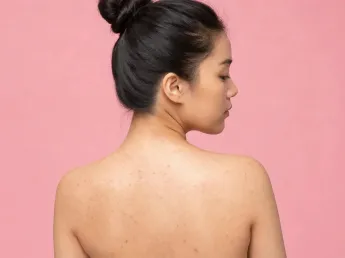
Back acne causes are the key to treating it effectively. Back acne (also called truncal acne or backne) is acne that develops on the back, shoulders, and upper arms — areas rich in sebaceous glands, similar to the face.
How common is it?
According to the NHS, back acne affects more than half of people with acne, making it one of the most common acne locations after the face. Chest acne occurs in about 15% of acne patients.
Types of acne found on the back
Comedones (blackheads/whiteheads) — clogged pores, non-inflammatory, often the starting point
Papules — mildly inflamed red bumps, tender to touch
Pustules — white-tipped, moderately inflamed
Nodules/cysts — large, deep, painful; highest risk of leaving scars
What Causes Back Acne?
Back acne does not have a single cause — it results from several factors working together:
1. Sweat and moisture build-up
When sweat mixes with oil and dead skin cells, it clogs pores. Tight clothing or non-breathable fabric traps this moisture longer, allowing bacteria to thrive.
2. Excess sebum production
Sebaceous glands on the back are larger than those on the face. When stimulated by androgens, they overproduce sebum, leading to clogged pores.
3. Cutibacterium acnes (C. acnes) bacteria
This bacterium normally lives on everyone's skin, but when pores become blocked, it multiplies rapidly and triggers inflammation, causing pustules and nodules.
4. Hormones
Elevated testosterone and androgen levels directly stimulate sebaceous glands. This peaks during puberty, menstrual cycles, or with use of certain steroids or progestins.
5. Hair products and conditioners
Conditioners and hair masks with high oil or silicone content can drip down the back during showering and clog pores — especially if not rinsed off thoroughly.
6. Stress and poor sleep
Stress raises cortisol, which indirectly stimulates sebaceous glands. Insufficient sleep also reduces the skin's immune response, slowing recovery from inflammation.
7. Genetics
People with first-degree relatives who have acne are at three times the risk (NCBI StatPearls). Back acne follows the same inheritance pattern.
How Is Back Acne Different From Facial Acne?
Though driven by the same mechanism, back acne has specific characteristics that make it harder to treat than facial acne:
Thicker skin and larger pores
Back skin is roughly 2–3 times thicker than facial skin, requiring higher-concentration active ingredients and longer treatment durations.
Physical inaccessibility
Applying cream or lotion to the back — especially the centre — is physically difficult. This is why spray formulations are far more practical for back acne than creams.
Friction and pressure
Sleeping on the back, wearing backpacks, and tight clothing all create ongoing friction that worsens inflammation — unlike facial acne which experiences far less mechanical pressure.
More sweat build-up
The back has high sweat-gland density. During exercise or sleep, moisture accumulates and creates an environment where C. acnes bacteria thrive.
Hair product residue
Facial acne is rarely caused by conditioners, but back acne has a significant trigger from hair care products dripping down during showering.
How to Treat Back Acne — Step by Step
Effective back acne treatment requires multiple steps together, not just a single product:
Step 1 — Cleanse with the right product
Regular body soap is not sufficient for back acne. Use a soap or body wash with Sulfur or Salicylic Acid to remove dead skin cells and prevent pore clogging.
Oxe'Cure Sulfur Soap — A bar soap with Sulfur 2.5% that reduces sebum production, controls oiliness, and fights bacteria. Suitable for daily back acne use. Lather on the back, leave for 1–2 minutes, then rinse off.
Step 2 — Apply a Salicylic Acid back spray after showering
Sprays are the most convenient format for back acne, reaching areas the hand cannot. Two strength options:
Oxe'Cure Body Acne Spray SA 1% — Salicylic Acid 1%, suitable for sensitive skin, early-stage acne, or first-time SA users. Gentle with minimal irritation.
DERMEDY Back Acne Spray SA 2% — Salicylic Acid 2%, suitable for multiple inflamed lesions or skin already tolerant to SA. Stronger exfoliation and antibacterial action.
Morning and evening routine comparison for back acne
Step
Morning
Evening / post-exercise
Cleanse
Oxe'Cure Sulfur Soap — lather on back 1–2 min
Oxe'Cure Sulfur Soap — lather on back 1–2 min
Spray
Oxe'Cure SA 1% (sensitive skin) or DERMEDY SA 2% (inflamed acne) — apply after towel dry
Same as morning — spray after shower, let dry before dressing
Products alone are not enough if behaviours continue triggering breakouts. These habits must go hand-in-hand with treatment:
Shower immediately after exercise
Sweat left on the back for more than 30 minutes allows C. acnes bacteria to multiply rapidly. If showering immediately isn't possible, use body wipes as a temporary solution.
Choose breathable clothing
100% cotton or moisture-wicking fabrics reduce moisture build-up. Avoid tight or synthetic clothing during exercise or hot weather.
Wash bedding regularly
Bedding accumulates oil, sweat, and dead skin cells. Wash every 1–2 weeks, or weekly during active breakouts.
Rinse hair products thoroughly
When using conditioner or hair masks, rinse off before the final body wash, and avoid letting foam or liquid run down the back. Try bending forward to rinse hair away from your back.
Do not squeeze or scratch
Squeezing back acne risks spreading bacteria and causes deeper scarring — especially nodules, which often rupture deeper inward when squeezed.
Watch your diet
High-sugar and high-glycaemic-index foods spike insulin, which increases androgen and sebum production. Reducing sugar, processed snacks, and sweet drinks can help.
Dark Marks After Back Acne — How to Manage PIH
After acne heals, it often leaves dark or red marks called PIH (Post-Inflammatory Hyperpigmentation) — a concern for many people just as significant as the acne itself.
Why are back marks darker than on the face?
Back skin produces more melanin in response to inflammation because it has larger sebaceous glands and pores. Severe inflamed acne leaves deeper and darker marks than on the face.
Ways to fade marks faster
Azelaic Acid — directly reduces melanin synthesis. Can be used daily, low irritation. (Skinoren contains 15–20% Azelaic Acid)
Niacinamide — reduces melanin transfer to skin. Suitable for sensitive skin, can be paired with SA.
Vitamin C — antioxidant that brightens skin, though high concentrations may irritate.
Adapalene (Differin) — stimulates cell turnover and speeds mark fading. (Differin Gel 0.1%)
Sunscreen is essential
UV exposure stimulates melanin and darkens existing marks. If sun-exposed (swimming, outdoor exercise), apply SPF 30+ sunscreen to the back — otherwise marks deepen and take much longer to fade.
PIH on the back typically fades in 3–6 months with consistent product use and sun protection.
Most back acne can be treated at home with label-directed products, but these signs mean it is time to see a dermatologist:
❗ Large nodules or cysts >1 cm diameter, very painful, hard to the touch
❗ 6–8 weeks of self-treatment with no improvement or worsening condition
❗ Fever, unusual swelling, skin hot around the acne — possible severe bacterial infection
❗ Raised, rope-like scarring (keloid) — especially in people with darker skin tones prone to keloid formation
❗ All bumps are itchy with no blackheads/whiteheads — could be Malassezia folliculitis (fungal, not acne)
Malassezia folliculitis vs. back acne — how to tell the difference
Malassezia folliculitis is a fungal infection of the hair follicle caused by overgrowth of the Malassezia yeast normally present on skin. It thrives in warm, humid conditions. Key differences from regular acne: uniformly sized bumps that itch intensely, no blackheads or whiteheads, typically spread in rows across the back, chest, or upper arms. Treatment requires antifungal medication, not standard acne products — which is why medical diagnosis is essential before treating.
Medical treatment options
A dermatologist may prescribe: oral antibiotics (Doxycycline, Minocycline), high-concentration topical retinoids, or Isotretinoin for severe cases.
Frequently Asked Questions
Mild comedones and small papules may resolve on their own in 4–8 weeks with proper care. However, pustules and nodules typically need treatment products — such as sulfur soap or SA spray — to shorten recovery and prevent dark marks. Left untreated, back acne often worsens due to ongoing sweat and moisture accumulation.
Initial improvement (lesions reduce, less inflammation) appears in 2–4 weeks with consistent daily use of sulfur soap and SA spray. Full results (significant reduction in acne) typically take 6–8 weeks. Dark marks (PIH) left behind fade over 3–6 months. Behavioural adjustments (shower post-exercise, change clothing) speed up the process.
Yes, daily use (morning and evening) is fine for back acne. Oxe'Cure Sulfur Soap with Sulfur 2.5% is formulated for regular use. How to use: lather on the back, leave for 1–2 minutes, then rinse. Helps control oil and reduce bacteria without excessive irritation. If skin feels dry after use, follow with an oil-free moisturiser.
Yes — using both together is highly recommended. The soap cleanses pores during bathing; the SA spray works continuously throughout the day after showering. Order: sulfur soap while bathing → towel dry → spray Oxe'Cure SA 1% or DERMEDY SA 2%, allow to dry → get dressed.
Yes — effective for large pimples with a head. Hydrocolloid patches absorb pus and reduce inflammation. Research has shown hydrocolloid dressings significantly reduce acne severity within 3–7 days. Tip: apply one patch per pimple before bed and leave overnight. For brand comparisons, see Best Acne Patch — Comparing 4 Top Brands
Three key differences: Malassezia folliculitis presents as uniformly sized bumps, intensely itchy, with no blackheads or whiteheads — spreads in lines across the back, chest, and upper arms, worsens in hot/humid conditions. Regular back acne has visible blackheads, whiteheads, or pus-filled heads; bumps vary in size; little or no itching. If uncertain, see a doctor — treatment is completely different: Malassezia requires antifungal medication, not acne products.
Address the root cause in 3 steps: (1) Shower within 30 minutes post-exercise using Oxe'Cure Sulfur Soap on the back → (2) Spray SA after towel drying → (3) Avoid synthetic fabrics during exercise, switch to cotton or moisture-wicking materials. If immediate showering isn't possible, change shirts and use body wipes on the back as a temporary measure.
Generally yes — men have higher testosterone levels causing sebaceous glands to produce more sebum. Men also typically sweat more and have thicker skin. NCBI notes that severe acne is more common in adolescent males, while adult women tend to have more hormonal acne on the face than the back. That said, back acne affects all genders and ages, and treatment with sulfur soap and SA spray is equally applicable to everyone.
⚠️ Disclaimer
The information on this page is for general informational purposes only and is not intended to replace professional medical advice, diagnosis, or treatment from a qualified doctor or pharmacist. If you have any questions about your symptoms or medication, always consult a doctor or pharmacist first.


 Metronidazole
 Vilerm
 Firide
 Gofen
Gofen Annylyn
 Sumigran
 Preme
Preme Tofago
 B-Ciprofloxacin
 Tansy One
 Enaril
 Nasonex