Understanding cold sore stages starts with knowing what causes them. A cold sore is an infection caused by herpes simplex virus type 1 (HSV-1) that produces small, clustered, fluid-filled blisters on or around the lips. It is also called a "fever blister," a name left over from the old belief that fever alone caused it.
Where do cold sores appear?
Cold sores most commonly appear on the lips, corners of the mouth, and the skin around the nose or chin. This differs from a canker sore, which forms inside the mouth (cheeks, tongue, or gums) — a cold sore is a skin-surface lesion, not a lining-of-the-mouth lesion.
Does it ever go away for good?
Once infected with HSV-1, the virus stays in your body for life, hiding dormant in nerve cells and reactivating periodically when triggered. This makes cold sores something you manage long-term rather than cure once and for all.
What Causes Cold Sores? HSV-1 vs HSV-2
Cold sores are caused mainly by herpes simplex virus (HSV), specifically HSV-1, which spreads through direct contact with saliva or sores — for example, kissing or sharing personal items.
How the first infection happens
When the virus first enters the body (primary infection), symptoms are often mild or absent. The virus then travels along nerve pathways and hides dormant in nerve ganglia (latency), later "waking up" to cause repeat outbreaks when triggered.
How HSV-1 differs from HSV-2
HSV-1 spreads mainly through saliva or oral secretions, making it the leading cause of cold sores. HSV-2 spreads mainly through sexual contact and is the more common cause of genital herpes. However, the two types can "cross over" through oral sex — HSV-1 from the mouth can spread to the genitals, and vice versa.
Virus type
Common location
Main transmission route
Chance of cold sore
Chance of genital herpes
HSV-1
Mouth and surrounding skin
Direct contact with saliva/sores, e.g. kissing
High (most common)
Possible (via oral sex)
HSV-2
Genitals
Sexual contact
Less common
High (most common)
Cold Sore Symptoms and Stages
Cold sores progress through clear stages — from itching and tingling before any blister appears, to scabbing and healing. Recognizing each stage helps you start antiviral treatment at the right time for the best results.
Stage 1 — Prodrome (warning stage)
Itching, tingling, burning, or numbness where the blister will appear, usually about 1 day before it becomes visible. This is when antiviral cream works best.
Stage 2 — Blister stage
A cluster of about 3-5 small fluid-filled blisters forms; the skin becomes red, swollen, and increasingly painful.
Stage 3 — Weeping/ulcer stage
The blisters break open and ooze clear or yellowish fluid. This is the most contagious stage.
Stage 4 — Crusting and healing
A golden-brown scab forms and gradually falls off on its own, usually without scarring.
Total healing time
Most cold sores clear up on their own within 7-10 days, with the scab typically falling off within about 6-14 days.
How Is Oral Herpes Transmitted?
Oral herpes spreads through direct contact with a sore or with oral secretions — and can still spread even when no blister is visible.
Main transmission routes
Kissing or close contact with an infected person
Sharing personal items such as cups, utensils, lip balm, or towels
Oral sex — can also spread the virus to the genitals
Spreading without symptoms (asymptomatic shedding)
A fact many people don't know: the skin can shed the virus even without a visible sore, meaning some infected people unknowingly pass it on. Avoiding close contact whenever you feel unusual itching or tingling helps lower this risk.
What it does NOT spread through
Oral herpes does not spread through toilet seats, bedding, or swimming pools, since the virus does not survive long outside the body.
What Triggers a Cold Sore Recurrence?
Cold sores recur when a trigger "wakes up" the virus that has been lying dormant in the nerve ganglia.
Common triggers
Accumulated stress — studies show a clear link between chronic stress and HSV-1 recurrence
Fever or illness — outbreaks occur notably more often during febrile illness
Sun / UV exposure — especially on unprotected lips
Hormonal changes — such as around menstruation
Certain nutritional deficiencies — such as low zinc or vitamin D
Weakened immunity — from lack of sleep or immune-suppressing conditions
Once you know your own triggers, avoiding or managing them ahead of time can help reduce how often cold sores come back.
Cold Sore vs Canker Sore vs Angular Cheilitis
A cold sore is a contagious viral lesion outside the lip, while a canker sore forms inside the mouth and angular cheilitis appears at the corners of the mouth — neither of the latter two is caused by the herpes virus, and neither is contagious.
These three conditions are often confused because of their similar locations. The table below compares the key distinguishing features:
Condition
Sore location
Cause
Contagious?
Appearance
Initial self-care
Cold sore
Outside the lip / around mouth
HSV-1 virus
Contagious
Clustered fluid blisters, then crusting
Antiviral cream + cold compress
Canker sore
Inside mouth (cheek/tongue)
Unclear/stress-related
Not contagious
Shallow white-yellow ulcer, red border
Saltwater rinse + avoid irritating foods
Angular cheilitis
Corners of mouth
Fungal/bacterial
Usually not contagious
Cracked, red, inflamed skin at mouth corner
Antifungal/anti-inflammatory cream + keep dry
Cold Sore Treatment Overview
Cold sore treatment centers on antiviral medication combined with self-care — the earlier you start at the first tingling sign, the faster it heals.
Topical antivirals
Acyclovir cream is the main option, applied to the area as soon as tingling begins. It shortens the contagious period and speeds up healing.
Oral antivirals
For frequent or severe recurrences, a doctor or pharmacist may consider an oral antiviral for more complete systemic control.
Self-care while healing
Apply a cold compress early on to reduce swelling and pain
Avoid picking at or touching the sore repeatedly
Wash your hands before and after applying any cream
Use SPF lip balm when going out in the sun
Cream or pill — how to choose
For occasional, mild cold sores, cream alone is usually enough. If outbreaks recur more than 6 times a year or symptoms are severe, consult a pharmacist or doctor about adding an oral antiviral.
🛒 If you notice early tingling or a new blister, ask a pharmacist about antiviral creams such as Vilerm, or browse the full acyclovir category
Genital Herpes vs Oral Herpes (Brief)
Genital herpes is caused by the same virus family (usually HSV-2), but differs from oral herpes in location and main transmission route.
The virus can "cross over" through oral-genital contact, meaning someone with a cold sore can, in some cases, pass the infection to a partner's genitals. Overall symptoms are similar (itching, blisters, sores) — only the location differs. This article focuses mainly on oral cold sores; if you have concerns about genital herpes specifically, consult a pharmacist or doctor directly for proper evaluation.
How to Prevent Cold Sores From Coming Back
You can reduce cold sore recurrence by managing your known triggers and supporting your immune system.
Avoid close contact while you have a blister or sore, or whenever you feel unusual tingling
Don't share personal items such as cups, towels, or lip balm
Use SPF lip balm during prolonged sun exposure
Get enough rest and manage chronic stress
Support overall health with a balanced diet and regular exercise
Ask a pharmacist or doctor about preventive antiviral medication if recurrences are unusually frequent
Possible Complications of Cold Sores
Most cold sores are harmless, but in some cases they can spread or cause more serious effects than expected.
Spread to the eye (ocular herpes) — touching a sore and then your eye without washing your hands can cause an eye infection that needs prompt treatment
Widespread infection in immunocompromised people (eczema herpeticum) — seen in those with chronic skin conditions or weakened immunity, symptoms can be more severe than usual
Rare but serious complications such as encephalitis (brain infection) — uncommon, but requires urgent treatment
Emotional/confidence impact from frequent recurrences in a visible location
If a sore spreads near the eye, or symptoms are unusually severe, see a doctor immediately rather than continuing self-care alone.
When to See a Doctor or Pharmacist
See a pharmacist or doctor right away if symptoms are severe, spreading quickly, or recurring unusually often.
❗ The sore is spreading near the eye
❗ High fever accompanies it, or this is an unusually severe first episode
❗ Recurrences happen more than 6 times a year
❗ Weakened immunity — e.g., undergoing chemotherapy, living with HIV, or pregnant
❗ The sore hasn't improved within 10 days
If one or more of these apply, consult a pharmacist or see a doctor to evaluate your symptoms and choose the right treatment approach.
Summary — Managing Cold Sores and Preventing Recurrence
Cold sores can be managed with the right antiviral treatment and by reducing your personal triggers. If you're unsure, consult a pharmacist or doctor.
Three key habits help you live comfortably with cold sores: (1) start antiviral cream at the first tingling sign, (2) reduce the triggers you know affect you, and (3) watch for warning signs that need a doctor's attention. Read more in our cold sore article series — covering treatment options, antiviral creams, acyclovir, and how to tell cold sores apart from other mouth blisters.
Explore antiviral products such as Vilerm at Intimo Life, or browse the full acyclovir category — and always consult a pharmacist before use.
Frequently Asked Questions
Herpes is caused by herpes simplex virus (HSV), which has two main types: HSV-1 (usually oral) and HSV-2 (usually genital). It spreads through direct contact with a sore or bodily secretions such as saliva.
Herpes is a viral infection that causes clustered fluid-filled blisters on the skin or mucous membranes, commonly at the mouth or genitals. Once infected, the virus stays dormant in nerve cells for life and can recur periodically.
It starts with itching, tingling, or numbness where the blister will form, followed by a cluster of about 3-5 fluid-filled blisters. These break open and ooze, then form a golden-brown scab that eventually falls off on its own.
Early symptoms (the prodrome stage) are usually itching, tingling, or a burning sensation where the blister will appear — about 1 day before it becomes visible. Applying antiviral cream at this stage gives the best results.
Cold sores typically clear up on their own within about 7-10 days, with the scab falling off within 6-14 days. Starting antiviral cream early can help speed up healing.
It spreads through direct contact with a sore or secretions — kissing, or sharing personal items like cups, towels, or lip balm. It can also spread even without a visible blister (asymptomatic shedding).
Antiviral cream containing acyclovir is the main option. Start using it as soon as you feel the early tingling or itching for the best results, and consult a pharmacist first to confirm the right strength and how to use it.
Apply a cold compress early to reduce swelling, use antiviral cream from the first tingling sign, avoid picking at or touching the sore, avoid strongly spicy or acidic foods that may irritate the area while it heals, and get enough rest.
⚠️ Disclaimer
The information on this page is for general informational purposes only and is not intended to replace professional medical advice, diagnosis, or treatment from a qualified doctor or pharmacist. If you have any questions about your symptoms or medication, always consult a doctor or pharmacist first.



 Metronidazole
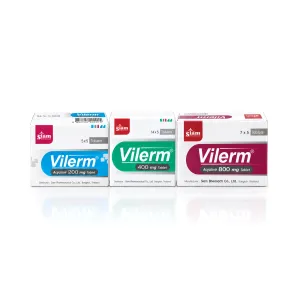 Vilerm
 Firide
 Gofen
Gofen Annylyn
 Sumigran
 Preme
Preme Tofago
 B-Ciprofloxacin
 Tansy One
 Enaril
 Nasonex