

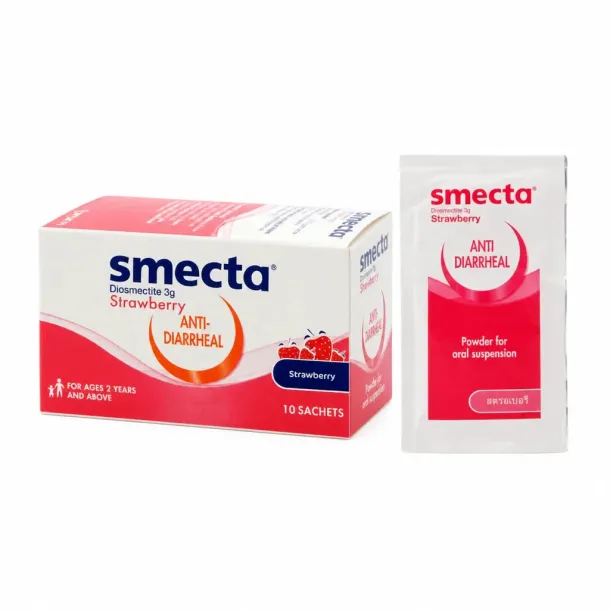

Dioctahedral Smectite
Smecta — anti-diarrheal powder, adsorbs toxins, coats intestinal wall, reduces loose stools. Safe for all ages.
💊 Active: Dioctahedral Smectite
⏱️ Usage: 1 sachet in 50-100 ml water, 3×/day
🍽️ Condition: Before/after meals; 2 hrs from other meds
📦 Pack: 10 sachets/box, orange-vanilla or strawberry
⚡ Benefit: Adsorbs toxins without bloodstream absorption
🌡️ Storage: Below 30°C, away from sunlight
Done — we will alert you on LINE when this item is back.
Remind me to reorder
Remind me every
First reminder 23 Oct 2026 · on LINE
Shipping
Discreet shipping within Thailand — packaging does not identify the product. Customers can review shipping and return conditions per our store policy. Contact our team for any questions.
What is Smecta?
Smecta is an oral powder for treating diarrhea. Its active ingredient, Dioctahedral Smectite, is a natural purified clay that absorbs toxins and pathogens in the intestines while coating the intestinal wall to reduce irritation and watery stools. Suitable for children and adults, dissolve 1 sachet in 50-100ml water, taken 3 times daily, spaced 2 hours from other medications. Comes in 2 flavors, 10 sachets per box.
🛒 10 sachets/box · Authentic · Fast delivery in 24h. Intimo Life — Consult a doctor or pharmacist before use
Product Description
Smecta is an anti-diarrheal powder containing Dioctahedral Smectite — a natural clay mineral: instead of slowing intestinal motility, Smecta adsorbs toxins and pathogens directly while coating the intestinal wall to reduce irritation. Stools consolidate and frequency of loose bowel movements decreases. Because it is not absorbed into the bloodstream, Smecta is safe for young children, pregnant women, and breastfeeding mothers.
📊 Key statistics:
- Acute diarrhea affects 1.7 billion people per year worldwide (WHO, 2023)
- Dioctahedral Smectite has a surface area of up to 100 m²/g — far greater than standard activated charcoal
- Studies show Smecta reduces diarrhea duration in children by an average of 27 hours when combined with ORS (ESPGHAN 2018)
- Pairs well with Magesto-F for diarrhea combined with indigestion
🏭 Manufactured by Ipsen Group, France. Registered with Thailand FDA.
⚠️ If diarrhea persists beyond 48 hours, high fever, or blood in stools — see a doctor.

About Smecta
What is Smecta?
Smecta is an anti-diarrheal powder containing Dioctahedral Smectite — a natural layered aluminosilicate clay mineral discovered in France and developed by Ipsen Group.
Mechanism of action:
- Adsorption of toxins — Smecta's surface carries both positive and negative charges that attract and bind bacterial, viral, fungal, and protozoan toxins
- Mucosal protection — When Smecta contacts the intestinal lining, it forms a temporary protective layer, reducing irritation from pathogens and toxins
- Not absorbed into bloodstream — Dioctahedral Smectite is not absorbed; it is excreted with feces with no systemic effects
Smecta differs from loperamide-type anti-diarrheals (which slow intestinal motility) — Smecta does not cause post-dose bloating and is not contraindicated in true infectious diarrhea.
What does Smecta treat?
Smecta is an anti-diarrheal used to treat:
- Acute diarrhea — from food poisoning, contaminated water, bacteria, viruses, or protozoa
- Chronic diarrhea — in irritable bowel syndrome or malabsorption (as adjunct therapy)
- Drug-induced diarrhea — such as antibiotic-associated diarrhea
- Diarrhea in children — Smecta is well-established for safety in children from birth, used alongside ORS (oral rehydration salts)
- Diarrhea during pregnancy — because it is not absorbed, Smecta is safe for pregnant and breastfeeding women (consult a doctor first)
Smecta is not an antibiotic — in cases of severe bacterial infection, antibiotic therapy may be needed alongside Smecta.
How to take Smecta / Dosage
How to dissolve correctly: Pour 1 sachet into a glass of 50-100 ml water and stir until fully dissolved. Drink immediately — do not let it sit.
Adult dosage:
- Acute diarrhea: 2 sachets per dose, 3 times daily (6 sachets/day) for the first 3 days, then reduce to 1 sachet 3 times daily
- Chronic symptoms: 1 sachet 3 times daily
Children's dosage:
- Under 1 year: 1 sachet/day divided into 2-3 doses, mixed into milk or food
- 1-2 years: 1-2 sachets/day
- Over 2 years: 2-3 sachets/day (same as adult)
Important timing:
- Can be taken before or after meals, but should be taken at least 2 hours apart from other medications — Smecta may adsorb other drugs
- Combine with ORS (oral rehydration salts) to replace lost fluids and electrolytes
- Increase water intake to at least 2 liters per day
Side effects of Smecta
Smecta has an excellent safety profile because it is not absorbed into the bloodstream. However, some side effects may occur:
Common (>5%):
- Constipation — most common side effect, especially with prolonged use or high doses. Managed by increasing fluid intake.
- Mild abdominal discomfort — may occur as the powder adsorbs intestinal gas
Uncommon (<1%):
- Mild nausea, especially at higher doses during the first 3 days
- Temporary bloating
Allergic reaction (very rare):
- Rash, swelling, or difficulty breathing — stop immediately and seek medical attention
Note: Smecta does not cause drowsiness, has no CNS effects, and is not habit-forming.
Contraindications / Precautions for Smecta
Contraindications:
- Known allergy to Dioctahedral Smectite or any excipient
- Intestinal obstruction
Special precautions:
- Drug interactions: Smecta adsorbs other medications — take at least 2 hours apart from antibiotics, vitamins, and diabetes medications
- Infants: Safe under medical guidance; always combine with ORS
- Pregnancy and breastfeeding: Generally considered safe, but consult a doctor before use
- Diabetes patients: Some Smecta formulas contain sugar — check the label
- Stool color: The powder may turn stools white or light grey during use — this is normal
When to stop and see a doctor:
- Diarrhea persists beyond 48 hours
- High fever (>38.5°C) or chills
- Blood or mucus in stools
- Signs of dehydration: extreme dry mouth, decreased urination, severe dizziness
Can Smecta be taken with other medicines?
Because Smecta has strong adsorption properties, it may bind other medications in the stomach and intestines, reducing their absorption into the body.
Medicines requiring spacing (take 2 hours apart):
- Antibiotics (e.g., Amoxicillin, Ciprofloxacin) — concurrent use reduces antibiotic blood levels
- Diabetes medications (e.g., Metformin) — take Smecta well apart
- Oral contraceptives — if diarrhea occurs while on the pill, take Smecta 2 hours apart and use backup contraception for that cycle
- Vitamins and minerals — separate to ensure full absorption
Safe to combine (and recommended):
- ORS (oral rehydration salts) — take alongside Smecta to replace fluids lost from diarrhea
- Probiotics — help restore gut flora; take at least 2 hours after Smecta
How fast does Smecta work?
Smecta begins adsorbing toxins within 30 minutes of ingestion, because the active ingredient works directly in the intestinal tract without needing to be absorbed into the bloodstream.
Expected timeline:
- 30 minutes: Smecta starts coating the intestinal wall and binding toxins
- 1-3 hours: Loose stools begin to consolidate, abdominal discomfort subsides
- 24-48 hours: Most cases of acute diarrhea show significant improvement
- 3-5 days: Full recovery for most people; do not use continuously beyond 5 days without medical advice
Factors that slow recovery: insufficient fluid intake, continuing to eat spicy/fatty/dairy foods, or bacterial infection requiring antibiotics.
Where to buy Smecta?
Where to buy Smecta?
Order Smecta online at Intimo Life — delivery across Thailand in 1-3 business days. Discreet packaging with no product details on the parcel. Available in orange-vanilla and strawberry flavors.
⚠️ ข้อจำกัดความรับผิดชอบ
เนื้อหาในบทความนี้มีจุดประสงค์เพื่อให้ความรู้ทั่วไปเท่านั้น ไม่ได้มีเจตนาทดแทนคำแนะนำ การวินิจฉัย หรือการรักษาจากแพทย์หรือเภสัชกรผู้เชี่ยวชาญ หากมีข้อสงสัยเกี่ยวกับอาการหรือการใช้ยา ควรปรึกษาแพทย์หรือเภสัชกรก่อนเสมอ
References
- WHO. Diarrhoeal disease — Fact sheet. World Health Organization. 2023.
- Drugs.com. Smecta — Patient Information. Drugs.com. 2024.
- NHS UK. Diarrhoea and vomiting — Treatment. NHS. 2023.
- ESPGHAN. Evidence-based Guidelines for the Management of Acute Gastroenteritis in Children. ESPGHAN. 2018.
- Mayo Clinic. Diarrhea — Symptoms and causes. Mayo Clinic. 2023.
Frequently Asked Questions
Smecta can be taken before or after meals — the active ingredient works directly in the intestines and does not depend on food. Some people prefer to take it 30 minutes before eating so it coats the gut lining first. More important than meal timing is separating Smecta from other medications by at least 2 hours, as it may adsorb other drugs.
Yes — Smecta is considered safe during pregnancy because Dioctahedral Smectite is not absorbed into the bloodstream and does not cross the placenta. However, always consult a doctor or pharmacist before taking any medication during pregnancy. Staying well-hydrated is essential to prevent dehydration.
Both contain the same active ingredient (Dioctahedral Smectite), but in different forms — Smecta (this product) is a powder sachet that must be dissolved in water, ideal for home or office use. Smecta Go is a ready-to-drink liquid in a tube or pouch — convenient for travel without any mixing. Efficacy is equivalent; choose based on convenience.
Constipation is a known side effect of Smecta, especially at higher doses or with prolonged use. Address it by increasing water intake (target 2 liters/day), eating more fiber-rich fruits and vegetables, and reducing the Smecta dose once diarrhea improves. If constipation persists beyond 2 days or is accompanied by significant abdominal pain, consult a pharmacist.
Yes — Smecta has been extensively studied in children of all ages, including newborns. The dose for infants under 1 year is 1 sachet per day divided into 2-3 doses, mixed into milk or food. However, diarrhea in infants can cause rapid dehydration — always combine with ORS and see a doctor immediately if the baby has high fever, lethargy, or vomiting.
Take it as soon as you remember, unless it is nearly time for your next dose (less than 1 hour away) — in that case, skip the missed dose and resume your regular schedule. Never double the dose to make up for a missed one, as this may increase constipation.
Smecta is the best choice when: diarrhea is from food poisoning or contaminated water, you need a medicine safe for both children and adults, you are pregnant or breastfeeding, or you have antibiotic-associated diarrhea. Unlike loperamide (e.g., Imodium) which slows intestinal motility, Smecta adsorbs toxins directly without suppressing intestinal movement — making it more suitable for infectious diarrhea.
No — Smecta should be stored at room temperature, below 30°C, in a dry place away from direct sunlight. Refrigeration is unnecessary. If sachets are repeatedly moved in and out of a fridge, condensation may cause the powder to clump — not harmful, but harder to dissolve.
Related Products
Products with the same active ingredient or treating the similar condition.
 Imodium (Loperamide) Anti-Diarrhoeal Capsules 6s
Relieves acute diarrhoea, fewer bowel movements fast
✓ In stock55.00 ฿(฿9.17/capsule) Erfuzide 200mg
Kills gut bacteria directly, not absorbed into the blood
✓ In stockFrom 40.00 ฿(฿2.38/capsule) Gastro Bismol
Antibacterial relief for travel diarrhea or food poisoning
✓ In stock148.00 ฿ Metronidazole
Treats bacterial vaginosis & abnormal vaginal discharge
✓ In stock40.00 ฿(฿4/tablet) Vilerm
Oral herpes treatment reduces recurrence
✓ In stockFrom 55.00 ฿(฿11/tablet)
Become a member of our store to receive news and exclusive discounts.