
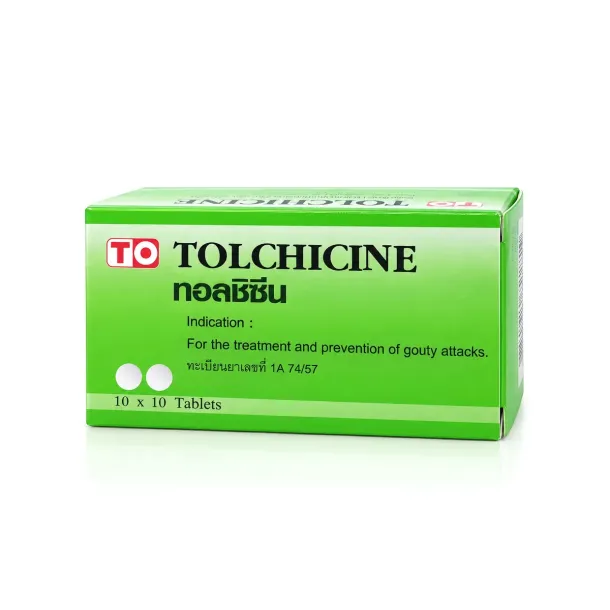
Colchicine
Tolchicine — Anti-inflammatory medication for high uric acid that relieves acute joint pain and swelling
💊 Active Ingredient — Colchicine
⚡ Fast-Acting — Relieves gout flare symptoms within 12-24 hours
🎯 Uric Acid-Specific — Targets inflammation from urate crystals specifically
🍽️ Can be taken with or without food
📦 Package — 1 box contains 10 strips (10 tablets per strip)
🏭 Manufactured by — T.O. Pharma
🌡️ Store below 30°C, protect from light and moisture
Done — we will alert you on LINE when this item is back.
Remind me to reorder
Remind me every
First reminder 26 Nov 2026 · on LINE
Shipping
Discreet shipping within Thailand — packaging does not identify the product. Customers can review shipping and return conditions per our store policy. Contact our team for any questions.
What is Tolchicine?
Tolchicine is an anti-inflammatory gout medicine containing Colchicine, used to relieve acute joint pain and swelling caused by uric acid crystals. It targets urate-crystal inflammation specifically and works fast, easing a gout flare within 12–24 hours. Take with or without food. It does not lower blood uric acid levels, so long-term control needs a separate medicine.
🛒 1 box (100 tablets) · Authentic · Fast delivery in 24 hrs · Intimo Life — Consult your doctor or pharmacist before use
Product Description
Gout medication is used to treat gout, a condition caused by high uric acid levels in the blood that crystallise in joints, causing severe pain, swelling, redness, and warmth. Tolchicine is an acute gout treatment containing Colchicine 0.6 mg, the same active ingredient as Colchicine — only the brand differs.
📊 Key Statistics
- Gout affects men 3-4 times more than women, especially those over 40, and is more common in those who consume beer, seafood, red meat, and organ meats
- Colchicine reduces inflammation caused by uric acid crystals but does NOT lower uric acid levels in the blood. Long-term management requires urate-lowering therapy (e.g., Allopurinol)
- The most common side effect is diarrhoea, which signals the need to reduce or stop the dose
- Browse other gout medications in the Gout collection
🏭 Tolchicine is a Thai generic with Colchicine 0.6 mg identical to Colchicine from other brands. Thai FDA approved.
⚠️ Colchicine has a narrow therapeutic index (the effective dose is close to the toxic dose). Use carefully and never exceed the recommended dose. Do not combine with CYP3A4 inhibitors without medical advice.

About Tolchicine
What is Tolchicine?
Tolchicine is an oral acute gout treatment containing Colchicine 0.6 mg. It belongs to the Anti-gout drug class and is a Thai generic identical to Colchicine from other brands.
Colchicine works by inhibiting neutrophil (white blood cell) function triggered by uric acid crystals in the joints. Specifically, it inhibits microtubule polymerization, preventing white blood cells from migrating to the inflamed area and reducing the release of inflammatory mediators, thereby reducing pain, swelling, and redness.
Important: Colchicine does NOT lower uric acid levels in the blood. It cannot treat the root cause of gout and must be used alongside urate-lowering therapy (e.g., Allopurinol, Febuxostat) long-term to prevent flares.
What is Tolchicine Used For?
Acute Gout Flare: Tolchicine reduces pain, swelling, redness, and warmth in joints caused by uric acid crystal deposition. Most effective when taken as early as possible, within 12-36 hours of symptom onset.
Gout Prophylaxis: Low-dose (0.6 mg once or twice daily) used with the initiation of urate-lowering therapy (Allopurinol) to prevent gout flares during the first 3-6 months.
Familial Mediterranean Fever (FMF): Colchicine is the primary treatment for this condition.
What Tolchicine does NOT do:
- Does not lower blood uric acid levels
- Does not dissolve existing uric acid crystal deposits
- Is not a general painkiller — do not use for other types of pain
How to Take Tolchicine / Dosage
Acute gout flare (Low-dose regimen — currently recommended):
- Start with 1.2 mg (2 tablets) at onset of symptoms
- Followed by 0.6 mg (1 tablet) 1 hour later
- Maximum 1.8 mg within 1 hour
- No more Colchicine for at least 12 hours afterwards
Gout prophylaxis:
- 0.6 mg once or twice daily
- Used with Allopurinol during the first 3-6 months of urate-lowering therapy
Important:
- The earlier you take it, the more effective (within 12-36 hrs of symptom onset)
- Effectiveness drops significantly if taken after 36 hours
- Do not exceed the recommended dose — Colchicine has a narrow therapeutic index
- Dose reduction required for kidney or liver disease
Side Effects of Tolchicine
Common side effects:
- Diarrhoea — the most common; a sign of possible overdose. Reduce or stop the dose
- Nausea, vomiting
- Abdominal pain
Serious side effects (stop and seek immediate medical attention):
- Bone marrow suppression — low white blood cells, red blood cells, and platelets; may result from overdose
- Myopathy (muscle weakness) — seen in kidney disease patients or those taking Statins concurrently
- Neuropathy (nerve damage)
- Severe allergic reaction
Note: The low-dose regimen (1.2 mg + 0.6 mg) significantly reduces GI side effects compared to the older high-dose regimen, with equivalent efficacy.
Contraindications & Precautions
Do not use:
- Allergy to Colchicine
- Combined severe liver AND kidney disease
Critical drug interactions:
- Strong CYP3A4 inhibitors (Clarithromycin, Ketoconazole, Itraconazole, Ritonavir) — do NOT combine; causes toxic Colchicine blood levels, potentially fatal
- P-glycoprotein inhibitors (Cyclosporine) — increase Colchicine levels; dose reduction required
- Statins (cholesterol medications) — combination increases myopathy risk; use with caution
Dose adjustment required:
- Kidney disease — significant dose reduction needed
- Liver disease — dose reduction needed
- Elderly — higher toxicity risk
- Pregnancy — limited data; consult doctor
How Does Tolchicine Compare to Other Gout Medications?
Tolchicine vs. Colchicine: Identical active ingredient (Colchicine 0.6 mg). Only the brand differs. Same efficacy, side effects, and usage.
Tolchicine vs. NSAIDs (Indomethacin, Naproxen): NSAIDs are an alternative for acute gout. Cheaper with fewer short-term side effects, but contraindicated in kidney, stomach, or heart disease. Colchicine may be preferred when NSAIDs are contraindicated.
Tolchicine vs. Allopurinol: Different drug classes with different purposes. Allopurinol lowers uric acid for long-term prevention, while Tolchicine treats acute inflammation. Often used together — Colchicine for flare prophylaxis during the first 3-6 months of starting Allopurinol.
Can Tolchicine Be Taken with Other Medications?
Contraindicated combinations (in liver/kidney disease):
- Strong CYP3A4 inhibitors — Clarithromycin, Erythromycin, Ketoconazole, Itraconazole, Ritonavir, Nelfinavir — increase Colchicine to toxic levels
- Cyclosporine — P-glycoprotein inhibition causes Colchicine accumulation
Use with caution:
- Statins (Atorvastatin, Simvastatin) — increased myopathy risk; inform your doctor
- Fibrates (Gemfibrozil, Fenofibrate) — also increase myopathy risk
- Digoxin — Colchicine may increase Digoxin levels
Safe and recommended combinations:
- Allopurinol / Febuxostat — standard gout treatment combination. Colchicine prevents flares during initiation of urate-lowering therapy
Where Can I Buy Tolchicine?
Tolchicine is a pharmacist-dispensed medication. You can order online from Intimo Life.
Can I buy Tolchicine online?
Yes. Order through Intimo Life — select the product, consult with a licensed pharmacist online, and receive your medication at home.
Should I speak to a pharmacist before ordering?
Yes. This medicine should be used under the guidance of a pharmacist or doctor. Read the label and get advice before use, especially if you have an existing condition, take other medicines, or are pregnant or breastfeeding. The Intimo Life team will ask about your symptoms and health history before shipping. If symptoms do not improve or get worse, see a doctor.
How does Intimo Life ship orders?
We deliver nationwide in Thailand with discreet packaging — no product names on the outside.
⚠️ Disclaimer
The information on this page is for general informational purposes only and is not intended to replace professional medical advice, diagnosis, or treatment from a qualified doctor or pharmacist. If you have any questions about your symptoms or medication, always consult a doctor or pharmacist first.
References
- StatPearls — Colchicine. Sadiq NM, Robinson KJ, Terrell JM. NCBI Bookshelf. Updated January 2025.
- Sivera F, et al. "Colchicine for acute gout." Cochrane Database of Systematic Reviews. 2021.
- Dalbeth N, et al. "Mechanism of action of colchicine in the treatment of gout." Clinical Therapeutics. 2014.
- Colchicine — NHS UK.
- Colchicine (Oral Route) — Mayo Clinic.
- Colchicine — Drugs.com. Updated 2024.
- Colchicine — DrugBank Online.
- Colchicine — MedlinePlus, U.S. National Library of Medicine.

Frequently Asked Questions
No difference in the active ingredient. Both contain identical Colchicine 0.6 mg. Only the brand name, manufacturer, and packaging differ. Same efficacy, side effects, usage, and precautions. Choose whichever brand is more convenient and affordable.
No. Colchicine does not lower uric acid levels. It only reduces inflammation caused by uric acid crystals. To lower uric acid, you need urate-lowering therapy such as Allopurinol or Febuxostat, along with dietary and lifestyle modifications.
Diarrhoea is the most common side effect and signals that your body has received enough medication. Reduce or temporarily stop the dose. Stay well hydrated. Using the low-dose regimen (1.2 mg followed by 0.6 mg) instead of the older high-dose regimen significantly reduces diarrhoea.
Yes, and it is the standard treatment approach. When starting Allopurinol (urate-lowering therapy), gout flares may occur during the first 3-6 months due to shifting uric acid levels. Colchicine 0.6 mg once or twice daily helps prevent these flares — known as flare prophylaxis.
No difference in active ingredient, dosage, or efficacy. Generics must pass Bioequivalence testing to prove equivalent absorption and effectiveness. The differences are in branding, packaging, and price — generics are cheaper as they do not bear R&D costs.
Depends on the purpose. For acute gout flares, take only during attacks (1-2 days). For flare prophylaxis with Allopurinol, doctors usually recommend continuing for 3-6 months until uric acid levels stabilise. Do not stop without consulting your doctor.
Related Products
Products with the same active ingredient or treating the similar condition.
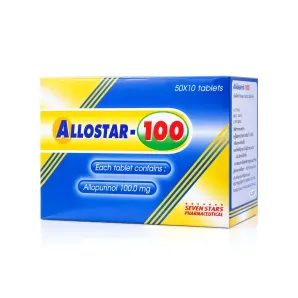 Allostar-100
Blocks uric acid production, prevents long-term gout flares
✓ In stock40.00 ฿