
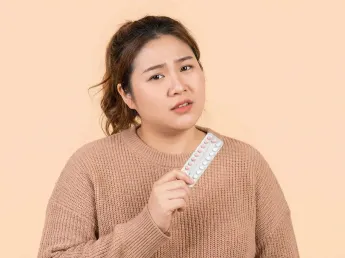
The myth that birth control pills cause weight gain — what does research actually say?
Does birth control really cause weight gain?
A Cochrane Review pooling 49 trials found that combined hormonal contraceptives (pills, patches, rings) do not cause a significant increase in weight
- ✅ Combined hormonal pills → no evidence found that they cause weight gain
- ⚠️ The injection (Depo-Provera) → may cause an average weight gain of ~2 kg over 6-12 months
- 💧 What feels like "getting fatter" is mostly temporary water retention, not fat accumulation
- 💊 Pills containing Drospirenone can help reduce water retention
- 🕰️ Older-generation pills had up to 150 micrograms of estrogen; today's formulas have just 20-35 micrograms, which retain far less water
- 🥗 Other factors — age, lifestyle, stress, and sleep — can also affect weight, not just the pill itself

Why do so many people believe birth control causes weight gain?
Does birth control cause weight gain? "Birth control makes you fat" is a belief that has run deep for decades — and it has to be said that, in the past, it wasn't entirely wrong.
The first generation of birth control pills, launched in the 1960s-1970s, contained very high amounts of estrogen — some formulas had as much as 150 micrograms of estrogen. That level of estrogen made the body retain more water and sodium, leading to bloating, weight gain, and a feeling of discomfort.
But today's birth control pills have changed a great deal. Estrogen content has dropped to just 20-35 micrograms — 4 to 7 times lower than the old formulas. Newer generations of progestins have also been developed that further reduce the water-retention side effect.
So the belief that "birth control equals weight gain" is a holdover from an earlier era, and it doesn't match the birth control pills used today.
What does the research say?
To answer this question as clearly as possible, we need to look at large studies that pool data from many trials.
Cochrane Review — 49 trials
The Cochrane Systematic Review, one of the most trusted medical evidence sources in the world, pooled and analysed 49 randomized controlled trials on combined hormonal contraceptives and body weight. Its conclusion:
- No evidence was found that combined hormonal pills or patches cause weight gain
- Women using birth control and those using a placebo showed no difference in weight change
- Comparing different birth control formulas also found no significant difference in weight
Research from Columbia University / PMC
Another study published on PMC looked at progestin-only contraceptives in 11,450 women and found that average weight gain over 6-12 months was less than 2 kg, with no meaningful difference in weight change between those using birth control and those using other contraceptive methods.
The exception: the birth control injection (Depo-Provera)
The one type of birth control with fairly clear evidence of causing weight gain is the DMPA injection (Depo-Provera). Research on it found:
- Average weight gain of 2.28 kg in the first year compared with users of the copper IUD
- Those who start at a younger age tend to gain more weight
- Most of the weight gained is fat, not water — unlike with the pill
| Type of birth control | Effect on weight | Evidence |
|---|---|---|
| Combined hormonal pill | ❌ No evidence of weight gain | Cochrane Review, 49 trials |
| Patch / vaginal ring | ❌ No evidence of weight gain | Cochrane Review, 49 trials |
| Progestin-only pill (mini-pill) | ⚠️ Slight weight gain (<2 kg/year) | Cochrane Review, 22 studies |
| Injection (Depo-Provera / DMPA) | ⚠️ Average weight gain ~2-3 kg/year | Multiple studies |
| Hormonal IUD | ⚠️ May slightly increase fat | Limited evidence |
So what actually causes that feeling of gaining weight?
If research shows the pill doesn't cause weight gain, why do so many people feel heavier after starting it? The answer comes down to 3 main factors:
Water retention — not fat
Estrogen in birth control pills stimulates the Renin-Angiotensin-Aldosterone (RAAS) system, causing the body to retain more sodium and water. The result is a feeling of bloating and a weight increase of 1-2 kg, especially in the first 1-3 months. But this is water, not fat, and it usually improves as the body adjusts.
Increased appetite — with some progestins
Some progestins may affect appetite, leading to eating more without realising it. Research from the University of Texas Medical Branch found that DMPA injection users who reported increased appetite were 3 times more likely to gain weight compared with those who did not have this symptom.
Other factors unrelated to birth control
Weight gain is often caused by other factors that happen to change around the same time someone starts birth control, such as:
- Age — metabolism naturally slows down
- Lifestyle — less exercise, eating more
- Stress — high cortisol makes fat easier to store
- Sleep — not sleeping enough disrupts hunger hormones
| Water Retention | Fat Gain | |
|---|---|---|
| Cause | Estrogen stimulates water retention | Overeating / lower metabolism |
| Location | All over — hands, feet, face | Builds up in the abdomen, hips, thighs |
| Duration | Temporary (first 1-3 months) | Gradually increases over time |
| Weight increase | 1-2 kg | More than 2 kg |
| How to tell | Skin dents when pressed / rings feel tight | Clothes feel permanently tighter |
| Fix | Reduce salt, drink water, wait for the body to adjust | Adjust diet, exercise |
How to choose a birth control pill without worrying about weight?
If you're worried about weight but still want to use birth control, here are some options to consider:
Low-dose estrogen combined pills
Pills containing 20-30 micrograms of estrogen have less effect on water retention than higher-estrogen formulas. Choosing a low-estrogen formula can help reduce bloating.
Pills containing Drospirenone
Drospirenone is a 4th-generation progestin with a special property: it is an antimineralocorticoid, which counteracts the sodium and water retention caused by estrogen. The result is reduced bloating, less abdominal distension, and better control of water-related weight gain. Research has found that users of Drospirenone-based pills tend to have stable or slightly reduced weight compared with other formulas.
Avoid the injection if weight is a concern
The injection (DMPA) is the only type with fairly clear evidence of causing real, fat-based weight gain. If weight is a concern, consider a different contraceptive method instead.
📖 Read more:
What to do if birth control makes you feel bloated?
If you start birth control and feel bloated or notice a slight weight gain, try these tips:
- Cut back on salty food — sodium makes the body retain more water. Cut down on processed food, snacks, and heavily salted dishes
- Drink enough water — it sounds counterintuitive, but drinking more water helps the body flush out excess fluid more effectively. Aim for 2-2.5 litres a day
- Exercise regularly — this stimulates blood circulation and the lymphatic system, which helps reduce water retention
- Give your body 2-3 months to adjust — bloating usually happens early on and improves as the body adapts to the hormones
- Ask a pharmacist — if symptoms don't improve after 3 months, you may need to switch to a formula that suits your body better, such as one containing Drospirenone
Frequently Asked Questions
Current medical evidence does not show that combined hormonal birth control — pills, patches or rings — causes a significant increase in weight. A Cochrane Review pooling 49 trials found no difference in weight change between birth control users and those using a placebo. The feeling of "getting fatter" early on is usually temporary water retention from estrogen, not real fat gain.
The DMPA injection (Depo-Provera) is the one type with fairly clear evidence of causing real, fat-based weight gain. Research found users gained an average of 2.28 kg in the first year compared with copper IUD users. If weight is a concern, ask a pharmacist about switching to a different method, such as a combined hormonal pill.
Water retention tends to show up all over the body — hands, feet, face — appears quickly in the first 1-3 months, and settles on its own. It's usually no more than 1-2 kg, and the skin dents when pressed. Real fat gain builds up gradually in the abdomen, hips and thighs, and clothes feel permanently tighter rather than the swelling going away by itself.
Yes — Drospirenone has an antimineralocorticoid effect that counteracts the sodium and water retention caused by estrogen more effectively than other progestins. Research found users of Drospirenone-based pills had stable or slightly lower weight compared with other formulas. Ask a pharmacist whether this formula suits your body before switching.
Bloating from birth control usually improves on its own within the first 2-3 months, once the body adjusts to the hormone levels. In the meantime, cut back on salty food, drink enough water, and exercise regularly to help the body flush out excess fluid. If symptoms haven't improved after 3 months, ask a pharmacist.
If weight keeps rising over several months and it isn't just temporary bloating, speak to a pharmacist or doctor. The cause may be unrelated to birth control — such as age, lifestyle changes, stress, or altered sleep — so it isn't always fair to blame the pill. A pharmacist can help work out what's actually driving the change.
Yes — the DMPA injection (Depo-Provera) has clearer evidence of causing weight gain than the pill, because it leads to real fat gain rather than just bloating. Combined hormonal pills, by contrast, show no evidence of causing weight gain in large studies. If weight is a concern, ask a pharmacist before choosing the injection.
Yes — choose a combined hormonal pill with low-dose estrogen (20-30 micrograms) or a Drospirenone-containing formula, both of which have less effect on water retention than other options, and avoid the injection if weight is a particular concern. Ask a pharmacist to help pick a formula that suits your body and health history.
⚠️ Disclaimer
The information on this page is for general informational purposes only and is not intended to replace professional medical advice, diagnosis, or treatment from a qualified doctor or pharmacist. If you have any questions about your symptoms or medication, always consult a doctor or pharmacist first.
References
- Cochrane Review — Combination contraceptives: effects on weight (Gallo et al., 2014)
- Cochrane Review — Progestin-only contraceptives: effects on weight (Lopez et al., 2016)
- PMC — Drospirenone/ethinyl estradiol: hormonal contraceptive choices (Bachmann & Kopacz, 2009)
- PMC — Early Weight Gain Predicting Later Weight Gain Among DMPA Users (Le et al., 2009)
- PMC — DMPA, weight gain and amenorrhea among obese women (Sims et al., 2020)
- Side effects and risks of hormonal contraception — NHS
- Cochrane — Evidence summary: combined hormonal contraceptives and weight (CD003987)
- Combined pill — NHS