
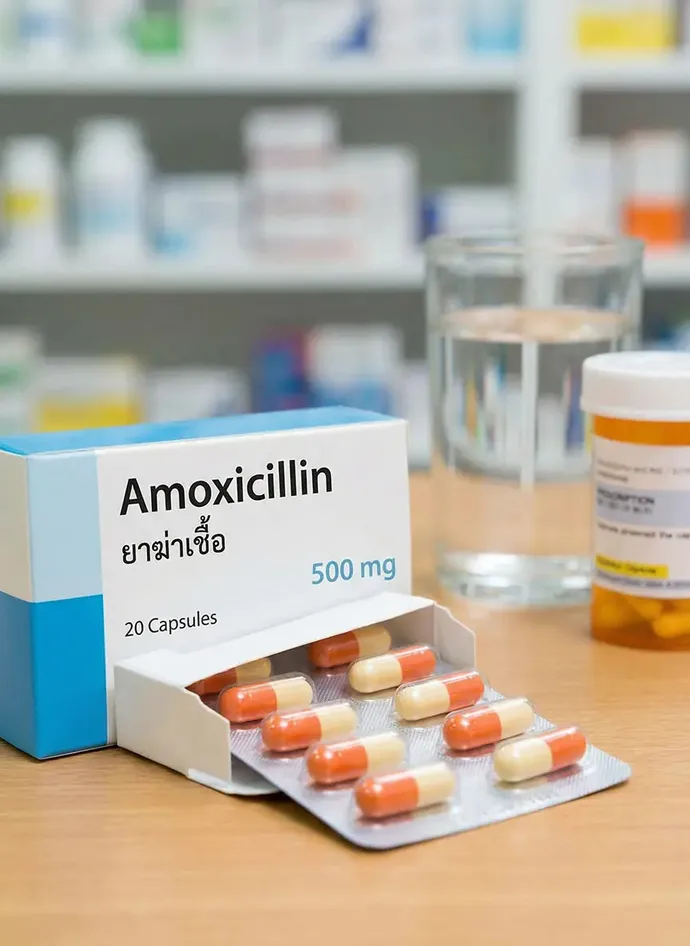
Amoxicillin
Amoxicillin — Antibiotic / Antibacterial
Amoxicillin is the most widely prescribed antibiotic in the world — trusted for decades and effective against a broad range of bacterial infections, from respiratory and urinary tract infections to dental abscesses and skin infections. Intimo Life offers Amoxicillin in both standard and enhanced formulations.
💊 Amoxicillin antibiotics available in both standard and Clavulanic Acid-enhanced formulations. Choose the one that fits your needs.
👨⚕️ Consult a pharmacist online instantly — no travel, no queues, completely private and convenient.
🚚 Fast, confidential delivery — plain packaging with no product names on the outside, delivered safely to your door.
What does Amoxicillin 500 mg treat?
Amoxicillin is a penicillin-class antibiotic used for a wide range of bacterial infections, covering certain gram-positive and gram-negative bacteria. The plain form suits general infections, while the version combined with clavulanic acid works better for more severe or resistant infections. Always finish the full course exactly as your pharmacist recommends.
🛒 Shop the range above · 24-hour dispatch from Intimo Life — consult a pharmacist if unsure.
Amoxicillin is a Penicillin-class antibiotic and one of the most commonly used antibacterial medications worldwide.
📊 Key facts about Amoxicillin:
- Listed on the WHO Model List of Essential Medicines — one of the most important drugs in global healthcare
- Provides broad-spectrum antibacterial coverage against many Gram-positive and some Gram-negative bacteria
- When combined with Clavulanic Acid, it gains the ability to overcome certain resistant bacteria that produce Beta-lactamase enzymes
💊 At Intimo Life, we offer two Amoxicillin options:
- Amoxicillin alone — For standard bacterial infections
- Amoxicillin + Clavulanic Acid (Augmentin) — For more severe infections or bacteria resistant to Amoxicillin alone
⚠️ Always complete the full course of antibiotics as prescribed. Stopping early — even if you feel better — can lead to antibiotic resistance.

Available Treatments
About Amoxicillin
What Is Amoxicillin?
Amoxicillin is an antibiotic belonging to the Penicillin family. It works by inhibiting the formation of bacterial cell walls, preventing bacteria from growing and dividing until they die.
It's important to understand that Amoxicillin is a "bacteria-killing" drug (antibiotic), not an "anti-inflammatory" drug. It only works against bacterial infections — it has no effect on viruses (such as the common cold or influenza). Taking antibiotics for viral infections is not only ineffective but contributes to the global crisis of antibiotic resistance.
What Can Amoxicillin Treat?
Amoxicillin has broad-spectrum coverage and is used to treat bacterial infections across multiple body systems.
🫁 Respiratory tract — Bacterial sinusitis / strep throat / bacterial bronchitis / middle ear infections (otitis media) / some cases of pneumonia
🦷 Oral and dental — Dental abscesses, post-extraction infections, bacterial gum infections
💧 Urinary tract — Certain urinary tract infections (cystitis)
🩹 Skin and soft tissue — Wound infections, abscesses, animal bite wounds (when combined with Clavulanic Acid)
🤢 Gastrointestinal — H. pylori infection in the stomach (used in combination with other medications such as PPIs for treating acid reflux and peptic ulcers)
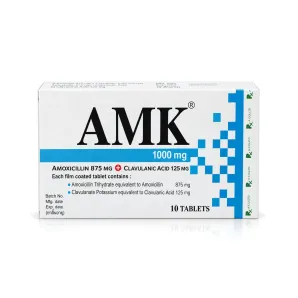
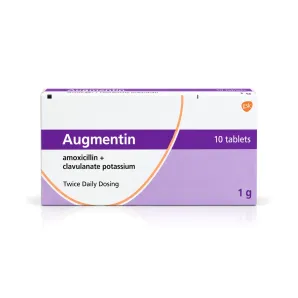
AMK vs Augmentin — What's the Difference?
Both contain Amoxicillin as the active ingredient, but with different formulations.
AMK — Amoxicillin alone — Pure Amoxicillin for treating standard bacterial infections where the bacteria haven't developed resistance. Suitable for strep throat, sinusitis, ear infections, and some urinary tract infections. Affordable and effective.
Augmentin — Amoxicillin + Clavulanic Acid — Includes Clavulanic Acid, which inhibits the Beta-lactamase enzyme that some bacteria produce to destroy Amoxicillin. This makes Augmentin effective against resistant bacteria. Ideal for more severe infections, resistant bacteria, or animal bite wounds.
In short: Standard infections → AMK is sufficient / More severe or potentially resistant infections → Augmentin
How to Take Amoxicillin Correctly
💊 Dosing — Typically taken three times daily (every 8 hours), e.g. morning, midday, and before bed, to maintain consistent blood levels / can be taken with or without food, but taking with food helps reduce nausea / for Augmentin specifically, taking at the start of a meal helps reduce diarrhoea
📅 Duration — Usually 5-7 days, or as prescribed by your pharmacist, depending on the type and severity of infection
⚠️ Most important rule — Always complete the full course. Even if you feel better after 2-3 days, do not stop early. Surviving bacteria can develop resistance and cause the infection to return. Antibiotic resistance is a global health crisis — completing your course is something everyone can contribute to.
Contraindications and Precautions
🚫 Absolute contraindication — Anyone with a known Penicillin allergy must not take Amoxicillin. Allergic reactions include hives, facial swelling, lip and tongue swelling, and difficulty breathing. Always inform your pharmacist if you've ever had a Penicillin allergy.
Precautions — Kidney disease patients may need dose adjustments / Amoxicillin may reduce the effectiveness of certain contraceptive pills — use backup protection during the course / inform your pharmacist about all other medications you're taking, as interactions are possible
Side Effects
Amoxicillin has a strong safety profile, but some side effects can occur.
Common side effects — Diarrhoea (more common with Augmentin due to Clavulanic Acid irritating the gut) / nausea, vomiting / skin rash (not always an allergic reaction — some rashes from Amoxicillin are non-dangerous)
Allergic reactions requiring immediate action — Hives, skin swelling / facial, lip, or tongue swelling / difficulty breathing, chest tightness / if any of these occur, stop the medication immediately and go to the emergency room
Antibiotics vs Anti-inflammatory Drugs — What's the Difference?
This is a very common source of confusion, especially in Thailand where antibiotics are colloquially called "anti-inflammatory drugs."
Antibiotics (e.g. Amoxicillin, Ciprofloxacin) — Kill or inhibit the growth of bacteria. Used only for confirmed bacterial infections. No effect on viruses.
Anti-inflammatory drugs / NSAIDs (e.g. Ibuprofen, Naproxen) — Reduce inflammation, pain, swelling, and fever. Work on both infectious and non-infectious inflammation. See our pain relievers collection for more.
Why the confusion? — When bacteria cause an infection, the body responds with inflammation (pain, swelling, redness, heat). When antibiotics kill the bacteria, the inflammation resolves too — leading people to call antibiotics "anti-inflammatory drugs." But the antibiotic didn't directly reduce inflammation; it eliminated the cause.
When NOT to Use Amoxicillin
Amoxicillin is not a cure-all. It should not be used in these situations.
❌ Common cold or influenza — These are viral infections. Antibiotics are completely ineffective.
❌ General sore throat — Most sore throats are caused by viruses, not bacteria. Don't take antibiotics without a proper diagnosis.
❌ Chronic cough not caused by bacteria — Coughs from allergies, asthma, or acid reflux don't need antibiotics.
❌ "Just in case" prevention — Never take antibiotics preventively without a medical indication. This is a major driver of antibiotic resistance.
Unnecessary antibiotic use is a leading cause of antibiotic resistance — a global health crisis. Always consult a pharmacist before using antibiotics.
Can I Take Amoxicillin with Other Medications?
Amoxicillin can be used alongside many medications, but some require caution.
✅ Generally safe together — Paracetamol, antihistamines, antacids such as Omeprazole
⚠️ Use with caution — Contraceptive pills (may reduce effectiveness — use backup protection) / Methotrexate — Amoxicillin may increase its levels / Warfarin — may need more frequent INR monitoring
Always inform your pharmacist about all medications you're currently taking before starting Amoxicillin.
The Antibiotic Resistance Crisis — Why Completing Your Course Matters
Antibiotic resistance is one of the most serious global health threats. Improper antibiotic use is the primary driver.
🔬 How does resistance develop? — When you don't finish a course, the strongest bacteria survive, multiply, and pass on their resistance. Their offspring are now harder to treat. Using antibiotics when they're not needed (e.g. for viral colds) also accelerates this process.
What everyone can do — Complete every antibiotic course as prescribed / never buy antibiotics without professional guidance / never share your antibiotics with others / never use leftover antibiotics from a previous course
⚠️ Disclaimer
The information on this page is for general informational purposes only and is not intended to replace professional medical advice, diagnosis, or treatment from a qualified doctor or pharmacist. If you have any questions about your symptoms or medication, always consult a doctor or pharmacist first.
Frequently Asked Questions
No. Amoxicillin is an antibiotic (bacteria-killing drug), while anti-inflammatory drugs are NSAIDs like Ibuprofen. In Thai, antibiotics are colloquially called "anti-inflammatory drugs" (ยาแก้อักเสบ), which causes confusion. They work in completely different ways.
No. The common cold is caused by a virus. Antibiotics have no effect on viruses. Taking them unnecessarily only contributes to antibiotic resistance. Only take Amoxicillin when a pharmacist or doctor has diagnosed a bacterial infection.
Signs that require immediately stopping the medication include hives, skin rash, facial or lip swelling, tongue swelling, and difficulty breathing. Severe cases can cause Anaphylaxis, which is a medical emergency. Always inform your pharmacist if you've ever had a Penicillin allergy.
Yes. Unlike Ciprofloxacin, Amoxicillin is not affected by milk or dairy products. You can take it with or without food.
It's a common side effect, as antibiotics kill both harmful and beneficial gut bacteria. This is more frequent with Augmentin due to the Clavulanic Acid component. Taking it with food helps, and you may consider probiotics after completing the course.
It depends on the infection. AMK (Amoxicillin alone) is sufficient for standard infections like strep throat or sinusitis. Augmentin is better for more severe infections or suspected resistant bacteria. Consult a pharmacist for the best recommendation.