

Naproxen
Long-Acting NSAID for Pain and Inflammation — Twice-Daily Dosing
Joint pain, muscle aches, gout flares, and period pain can disrupt daily life. Naproxen's long half-life provides all-day coverage with just twice-daily dosing — convenient for both acute and chronic pain.
💊 Available in 250 mg and 500 mg tablets. Always take with food. A pharmacist can guide you to the right strength.
👨⚕️ Consult a pharmacist online instantly — no travel, no queues, completely private and convenient.
🚚 Fast, confidential delivery — plain packaging with no product names on the outside, delivered safely to your door.
What is Naproxen?
Naproxen is an NSAID pain reliever that blocks inflammatory and pain-causing substances, covering joint and muscle pain, gout flares, and menstrual cramps. It relieves primary menstrual pain by 70-80% compared to placebo and lasts longer than Ibuprofen, so twice-daily dosing is enough. Avoid taking it on an empty stomach, or if you have stomach ulcers or severe kidney impairment. Consult a pharmacist first.
🛒 Shop the range above · 24-hour dispatch from Intimo Life — consult a pharmacist if unsure.
Naproxen is a non-selective NSAID inhibiting both COX-1 and COX-2, reducing prostaglandin synthesis — the mediator of inflammation, pain, and fever. It covers musculoskeletal conditions, acute gout, and primary dysmenorrhoea with the benefit of twice-daily dosing.
📊 Key clinical statistics:
- Naproxen achieves 70–80% reduction in primary dysmenorrhoea vs placebo — NSAIDs are the first-line pharmacological choice
- Half-life of 12–17 hours enables twice-daily dosing vs ibuprofen's 2-hour half-life requiring 3–4 daily doses
- Some CV outcome data indicate Naproxen carries a lower relative CV risk than Diclofenac and high-dose Ibuprofen
💊 At Intimo Life, Naproxen (นาพรอกเซน) covers key pain categories:
- Musculoskeletal and joint pain — osteoarthritis, rheumatoid arthritis, back pain, sprains
- Period pain and acute flares — dysmenorrhoea, acute gout, dental pain, tension headache
⚠️ Always take with food. Avoid in active peptic ulcer, severe renal or hepatic impairment, and third-trimester pregnancy. Consult a pharmacist before use with anticoagulants, antihypertensives, or other NSAIDs.

Naproxen
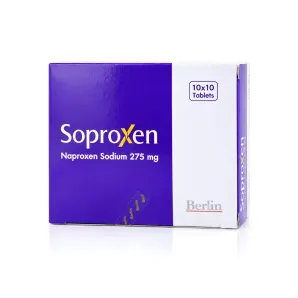 Soproxen
Relieves muscle, joint, period pain, and gout
✓ In stockFrom 45.00 ฿(฿2.5/tablet)
About Naproxen
What is Naproxen (นาพรอกเซน)? How does it work?
Naproxen is a non-selective NSAID that inhibits both COX-1 and COX-2 enzymes, blocking prostaglandin synthesis — the key mediator of inflammation, pain, and fever.
- COX-1 inhibition — reduces gastroprotective prostaglandins, explaining GI risk
- COX-2 inhibition — reduces prostaglandins at sites of tissue injury
- Half-life 12–17 hours — sustained action, twice-daily dosing sufficient
Available as free acid (250 mg, 500 mg) and as sodium salt (275 mg, 550 mg) — sodium form absorbs slightly faster for quicker onset. Consult a pharmacist to choose the right form.
What does Naproxen (นาพรอกเซน) treat? What are the main indications?
Naproxen (นาพรอกเซน) treats a wide range of pain and inflammatory conditions:
- Primary dysmenorrhoea — blocks uterine prostaglandins; highly effective for period pain
- Osteoarthritis and rheumatoid arthritis — reduces joint pain and inflammation, improving mobility
- Acute gout flare — suppresses the intense inflammatory response in affected joints
- Muscle pain, back pain, sprains — analgesic and anti-inflammatory for soft-tissue injuries
- Headache and dental pain — short-term acute pain management
Not recommended for children under 12 years except under direct medical supervision.
How to take Naproxen (นาพรอกเซน) correctly? When and how many tablets per day?
Always take Naproxen (นาพรอกเซน) with food or after a meal to protect the stomach lining.
- General pain (adults) — 250–500 mg twice daily (~12 hours apart); max 1,250 mg/day initially
- Primary dysmenorrhoea — 500 mg at onset, then 250 mg every 6–8 hours for up to 3 days
- Acute gout flare — 750 mg initially, then 250 mg every 8 hours until resolved
- Shortest effective duration — reassess with a pharmacist every 2–4 weeks for chronic use
If you miss a dose, take it as soon as you remember unless the next dose is due soon. Never double up.
What are the side effects of Naproxen (นาพรอกเซน)? Is it dangerous?
As a non-selective NSAID, Naproxen (นาพรอกเซน) carries a well-defined side-effect profile to be aware of:
- GI effects (most common) — nausea, dyspepsia, heartburn; gastric ulcer and GI bleeding risk rises with long-term use or higher doses
- Renal and fluid effects — fluid retention, oedema, possible blood pressure rise; caution in kidney impairment or heart failure
- Cardiovascular effects — long-term NSAID use may modestly increase CV risk; use lowest dose for shortest duration
- Allergic reactions — rash, breathing difficulty, facial swelling (rare; stop immediately)
Always take with food. Seek urgent pharmacist advice for black stools, blood in vomit, or severe abdominal pain.
Who should avoid Naproxen (นาพรอกเซน)? What are the key contraindications?
Specific groups must avoid Naproxen (นาพรอกเซน) or use it with caution:
- NSAID or aspirin allergy — absolute contraindication; includes aspirin-sensitive asthma
- Active peptic ulcer or GI bleeding — high risk of serious haemorrhage
- Severe renal or hepatic impairment — may precipitate acute kidney injury
- Third trimester of pregnancy — risk of premature foetal ductus arteriosus closure
- Drug interactions — Warfarin (bleeding risk), ACE inhibitors/ARBs (reduced effect), other NSAIDs (avoid), lithium (raised levels)
Elderly patients, those with cardiovascular disease, and anyone on multiple medications must consult a pharmacist before starting Naproxen.
Naproxen (นาพรอกเซน) vs Ibuprofen — what are the differences? Which one to choose?
Naproxen (นาพรอกเซน) and Ibuprofen are both non-selective NSAIDs, but differ in practical ways:
- Duration — Naproxen: 12–17 hour half-life, twice daily / Ibuprofen: ~2 hour half-life, 3–4 times daily
- Best indications — Naproxen: chronic conditions (osteoarthritis, gout) / Ibuprofen: acute short-term pain and fever (faster onset)
- CV risk — some evidence suggests Naproxen carries lower relative CV risk than high-dose Ibuprofen
- GI risk — similar for both; always take with food regardless of choice
The right NSAID depends on symptom pattern, dosing convenience, and health history. Consult a pharmacist for personalised guidance.
Naproxen generic vs brand — what is the difference? What are SOPROXEN and SYNFLEX?
Naproxen (นาพรอกเซน) is available as both generic and branded formulations containing the same active ingredient:
- Generic Naproxen — same active ingredient and strength; approved by Thai FDA; typically more affordable
- SOPROXEN — branded Naproxen sodium available in Thailand
- SYNFLEX — another branded Naproxen sodium product
- SONAP — Naproxen brand name used in some markets
Generic Naproxen must pass bioequivalence testing proving equivalent absorption and blood concentration vs the originator. At the same dose the effect should be equivalent. Discuss brand vs generic with a pharmacist based on your needs and budget.
⚠️ ข้อจำกัดความรับผิดชอบ
เนื้อหาในบทความนี้มีจุดประสงค์เพื่อให้ความรู้ทั่วไปเท่านั้น ไม่ได้มีเจตนาทดแทนคำแนะนำ การวินิจฉัย หรือการรักษาจากแพทย์หรือเภสัชกรผู้เชี่ยวชาญ หากมีข้อสงสัยเกี่ยวกับอาการหรือการใช้ยา ควรปรึกษาแพทย์หรือเภสัชกรก่อนเสมอ
- Naproxen — Patient Information Leaflet — NHS
- About Naproxen — Uses, Doses, Side Effects — NHS
- Naproxen — Drug Information — MedlinePlus (NIH)
- Nonsteroidal Anti-Inflammatory Drugs (NSAIDs) — NCBI StatPearls
- Naproxen — Drug Label Database — DailyMed (NIH)
Frequently Asked Questions about Naproxen
Naproxen can cause stomach burning or nausea because it inhibits COX-1, which produces protective prostaglandins in the stomach lining. Prevention: always take Naproxen with food and drink plenty of water. If stomach discomfort is significant or you have a history of peptic ulcer, consult a pharmacist — a gastroprotective agent may be recommended alongside Naproxen.
Generally yes — Naproxen and Paracetamol work through different mechanisms, and combining them can provide better pain control without needing to increase the dose of either drug alone. However, always inform your pharmacist of all medications you are taking before combining pain relievers, as individual health conditions may affect whether this combination is appropriate for you.
Naproxen is contraindicated in the third trimester of pregnancy — it can cause premature closure of the foetal ductus arteriosus, a serious and potentially life-threatening complication. Use in the first and second trimesters should also be avoided where possible and only considered after consulting a doctor or pharmacist. Paracetamol at the lowest effective dose remains the recommended analgesic during pregnancy.
Naproxen is not recommended for children under 12 years of age except under direct medical supervision, as safety data in young children is limited. For paediatric pain relief and fever, Paracetamol or children's Ibuprofen formulations are generally safer first-line options. Always consult a pharmacist before giving any pain medication to a child.
Taking Naproxen on an empty stomach is not recommended. NSAIDs reduce the prostaglandins that protect the stomach lining, so taking Naproxen without food significantly increases the risk of gastric irritation, ulcers, and GI bleeding. Always take Naproxen with a meal, after food, or at minimum with a full glass of milk to reduce GI side effects.
Yes — Naproxen is one of the most effective NSAIDs for primary dysmenorrhoea, directly suppressing the prostaglandins that cause uterine cramping. Recommended use: take 500 mg at the onset of pain, then 250 mg every 6–8 hours as needed for up to 3 days. Always take after food, and do not combine with other NSAID pain relievers at the same time.
Yes — Naproxen is effective for acute gout flare management, reducing the inflammatory response to uric acid crystals. Dosing: 750 mg initially, then 250 mg every 8 hours until the flare resolves. Gout patients often have comorbid kidney disease — always consult a pharmacist first, as NSAIDs can further reduce kidney function in susceptible individuals.
Naproxen (นาพรอกเซน) is available online at Intimo Life — consult our pharmacist via LINE before ordering for a personalised dose assessment. Generic Naproxen is typically more affordable than branded formulations; actual pricing depends on strength and pack size. Orders are dispatched quickly in plain packaging with no product names visible, ensuring complete privacy.
Recently viewed products