Nexium — A highly effective PPI acid reducer for treating acid reflux and stomach ulcers.
💊 Active Ingredient: Esomeprazole
🏭 Manufacturer: AstraZeneca (Original Brand)
💡 Mechanism: Inhibits acid secretion at the source, effective for up to 24 hours
📅 How to Take: Once daily, 30-60 minutes before breakfast. Swallow whole, do not chew or crush.
📦 Packaging: 14 tablets per box (2 strips of 7 tablets)
🌡️ Storage: Store below 30°C, away from moisture and sunlight
✨ Key Advantage: S-isomer of Omeprazole provides more consistent blood levels and better acid control than first-generation PPIs
Done — we will alert you on LINE when this item is back.
Remind me to reorder
Remind me every
First reminder 20 Oct 2026 · on LINE
Shipping
Discreet shipping within Thailand — packaging does not identify the product. Customers can review shipping and return conditions per our store policy. Contact our team for any questions.
What is Nexium?
Nexium is a Proton Pump Inhibitor containing Esomeprazole, used to treat GERD and stomach ulcers by suppressing acid production at the source. Its key benefit is a single dose lasting up to 24 hours. Take it once daily, 30-60 minutes before breakfast, swallowing the tablet whole without chewing or crushing it.
🛒 14 tablets/box (2 strips) · Authentic · Fast delivery 24 hrs. Intimo Life — Consult a doctor or pharmacist before use
Product Description
PPI acid-reducing medication is the most commonly prescribed treatment for gastroesophageal reflux disease (GERD) and peptic ulcers. Nexium is a Proton Pump Inhibitor (PPI) containing Esomeprazole — the S-isomer of Omeprazole — providing highly effective suppression of gastric acid secretion.
📊 Key Statistics
GERD (Gastroesophageal Reflux Disease) — Affects approximately 7–15% of the Thai population, with rising prevalence due to modern dietary habits
Esomeprazole reduces acid secretion by over 90% within 24 hours, accelerating ulcer healing
Nexium is manufactured by AstraZeneca, a leading global pharmaceutical company, as the originator brand of Esomeprazole
See other acid-reducing medications in the Digestive Health collection
🏭 Nexium is manufactured by AstraZeneca, a British-Swedish multinational pharmaceutical company and the developer of Esomeprazole. Approved by the Thai FDA and US FDA — the gold standard for treating GERD and peptic ulcers.
⚠️ PPIs should not be used continuously longer than recommended by your doctor. If symptoms do not improve within 2 weeks, consult your doctor for further evaluation.
Medically reviewed by
Supatcheree A., Pharmacist | Sources: NHS, StatPearls, Drugs.com
Last reviewed: 2026-02-17
About Nexium
What is Nexium?
Nexium is an oral acid-reducing medication containing Esomeprazole as its active ingredient. It belongs to the Proton Pump Inhibitor (PPI) drug class and is manufactured by AstraZeneca (UK–Sweden).
Esomeprazole is the S-isomer of Omeprazole. It works by irreversibly inhibiting H⁺/K⁺ ATPase (the proton pump) on parietal cells in the stomach — the final step of acid secretion — effectively suppressing hydrochloric acid (HCl) production.
Esomeprazole has higher bioavailability than Omeprazole due to slower metabolism via CYP2C19, resulting in higher plasma levels and longer duration of action. It reduces acid secretion by over 90% with continuous use.
Nexium is the originator brand of Esomeprazole, available in 20 mg and 40 mg strengths. It is one of the world's best-selling PPIs.
What is Nexium used for?
GERD (Gastroesophageal Reflux Disease): Nexium treats heartburn and acid reflux, both erosive esophagitis and non-erosive reflux disease. It promotes oesophageal ulcer healing and prevents relapse.
Peptic Ulcer Disease: Treats acid-related ulcers including gastric ulcers and duodenal ulcers, as well as NSAID-induced ulcers.
H. pylori Eradication: Used in combination with antibiotics (Triple Therapy) to eradicate Helicobacter pylori — the primary cause of peptic ulcers.
Zollinger-Ellison Syndrome: Treats conditions of excessive acid production caused by gastrinoma tumours.
Erosive Esophagitis: Esomeprazole 20–40 mg once daily for 4–8 weeks
Maintenance: 20 mg once daily
Peptic Ulcer:
Duodenal Ulcer: 20 mg once daily for 4 weeks
Gastric Ulcer: 20–40 mg once daily for 4–8 weeks
H. pylori Eradication:
Esomeprazole 20 mg + Amoxicillin 1 g + Clarithromycin 500 mg twice daily for 7–14 days
How to take:
Take 30–60 minutes before a meal (preferably before breakfast)
Swallow whole with water — do not crush, chew, or break the tablet
If you miss a dose, take it as soon as you remember. Skip if close to the next dose
Side Effects of Nexium
Common side effects:
Headache
Nausea
Diarrhoea or constipation
Abdominal pain, flatulence
Dry mouth
Less common side effects:
Skin rash
Dizziness
Insomnia
Serious side effects (rare, but important with long-term use):
C. difficile infection — severe diarrhoea from Clostridioides difficile colitis
Bone fractures — PPI use longer than 1 year may increase risk of hip, spine, or wrist fractures
Hypomagnesemia — may occur with use longer than 3 months, causing muscle cramps and cardiac arrhythmia
Vitamin B12 deficiency — long-term PPI use may reduce B12 absorption
Interstitial Nephritis — very rare kidney inflammation
Contraindications & Precautions
Do not use:
Allergy to Esomeprazole, Omeprazole, or other PPIs
Concurrent use with Rilpivirine (HIV medication) — contraindicated
Concurrent use with Nelfinavir — contraindicated
Use with caution:
Liver disease — severe hepatic impairment: do not exceed 20 mg/day as Esomeprazole is hepatically metabolised
Anticoagulants — Esomeprazole may enhance the effect of Warfarin; monitor INR
Clopidogrel — PPIs may reduce the efficacy of Clopidogrel via CYP2C19; consult your doctor
Pregnancy and breastfeeding — may be used when necessary but consult your doctor first
Long-term use — use the lowest effective dose for the shortest necessary duration to minimise risks
How Does Nexium Compare to Other Acid Reducers?
Nexium vs. Omeprazole: Esomeprazole (Nexium) is the S-isomer of Omeprazole with higher bioavailability and slower metabolism, resulting in higher plasma levels. In practice, both are similarly effective for typical GERD, but Esomeprazole may have an edge in severe erosive esophagitis. Nexium is the originator brand and more expensive than generic Omeprazole.
Nexium vs. Losec (Omeprazole originator): Losec is the originator Omeprazole brand, also by AstraZeneca. Both are PPIs from the same company — Nexium (Esomeprazole) is the refined S-isomer developed subsequently.
Nexium vs. other PPIs (Lansoprazole, Pantoprazole, Rabeprazole): All PPIs share the same mechanism. They differ in pharmacokinetics and drug interactions. Esomeprazole and Omeprazole have more drug interactions (via CYP2C19) compared to Pantoprazole or Rabeprazole. Choose based on indication and concurrent medications.
Nexium vs. H2 Blockers (Ranitidine, Famotidine): PPIs suppress acid far more potently than H2 Blockers. PPIs are appropriate for moderate-to-severe GERD and peptic ulcers. H2 Blockers are suitable for mild symptoms or occasional use.
How Long Does Nexium Take to Work?
Esomeprazole begins inhibiting the proton pump within 1 hour of ingestion, but full effect requires several days as newly generated proton pumps must also be inhibited.
Timeline:
1–2 hours: Drug starts working; acid secretion decreases; heartburn may begin to ease
1–4 days: Significant improvement in heartburn and reflux symptoms
1–2 weeks: Maximum acid suppression achieved; most symptoms resolve
4–8 weeks: Complete healing of oesophageal or gastric ulcers (for Erosive Esophagitis)
Important: Take 30–60 minutes before a meal because PPIs work best when proton pumps are active (preparing to secrete acid for digestion).
If symptoms do not improve within 2 weeks, consult your doctor for further evaluation such as endoscopy.
Where Can I Buy Nexium?
Nexium is a pharmacist-dispensed medication. You can order online from Intimo Life.
Can I buy Nexium online?
Yes. Order through Intimo Life — select the product, consult with a licensed pharmacist online, and receive your medication at home.
Should I speak to a pharmacist before ordering?
Yes. This medicine should be used under the guidance of a pharmacist or doctor. Read the label and get advice before use, especially if you have an existing condition, take other medicines, or are pregnant or breastfeeding. The Intimo Life team will ask about your symptoms and health history before shipping. If symptoms do not improve or get worse, see a doctor.
How does Intimo Life ship orders?
We deliver nationwide in Thailand with discreet packaging — no product names on the outside.
⚠️ Disclaimer
The information on this page is for general informational purposes only and is not intended to replace professional medical advice, diagnosis, or treatment from a qualified doctor or pharmacist. If you have any questions about your symptoms or medication, always consult a doctor or pharmacist first.
Nexium contains Esomeprazole, the S-isomer of Omeprazole, with slightly higher bioavailability and slower metabolism. In practice, both are similarly effective for typical GERD, but Esomeprazole may have a slight advantage in severe erosive esophagitis. Generic Omeprazole is significantly less expensive.
Long-term PPI use beyond what your doctor recommends is not advised without medical supervision. Extended use (over 1 year) may increase the risk of bone fractures, hypomagnesemia, B12 deficiency, and C. difficile infection. Use the lowest effective dose for the shortest necessary duration. If long-term use is needed, your doctor should monitor periodically.
PPIs work by inhibiting active proton pumps, which are most active when the body is preparing to secrete acid for digestion. Taking it 30–60 minutes before a meal ensures optimal drug activity. Taking it after meals or on a prolonged empty stomach reduces its effectiveness.
Esomeprazole has important drug interactions. Do not use with Rilpivirine and Nelfinavir. Use caution with Clopidogrel (may reduce efficacy), Warfarin (may enhance effect), Methotrexate (may increase levels), and Diazepam (may increase levels). Always inform your doctor or pharmacist about all medications you are taking.
Rebound acid hypersecretion may occur after stopping PPIs, especially after continuous use beyond 8 weeks. The body temporarily produces more acid than normal, causing heartburn to return. This usually resolves within 1–2 weeks. Gradually tapering the dose rather than stopping abruptly is recommended to minimise rebound symptoms.
Esomeprazole is approved for children aged 1 year and older for GERD, with dosage adjusted by body weight. Children 10–20 kg: 10 mg/day. Over 20 kg: 10–20 mg/day. Always consult a paediatrician or pharmacist before using in children.
Related Products
Products with the same active ingredient or treating the similar condition.




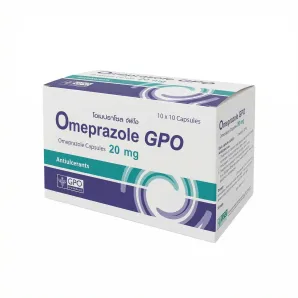 Omeprazole GPO 20mg
 Gaviscon Dual Action Sachets
 Gaviscon Peppermint
 Gaviscon Advance
 Gaviscon Peppermint Sachets