
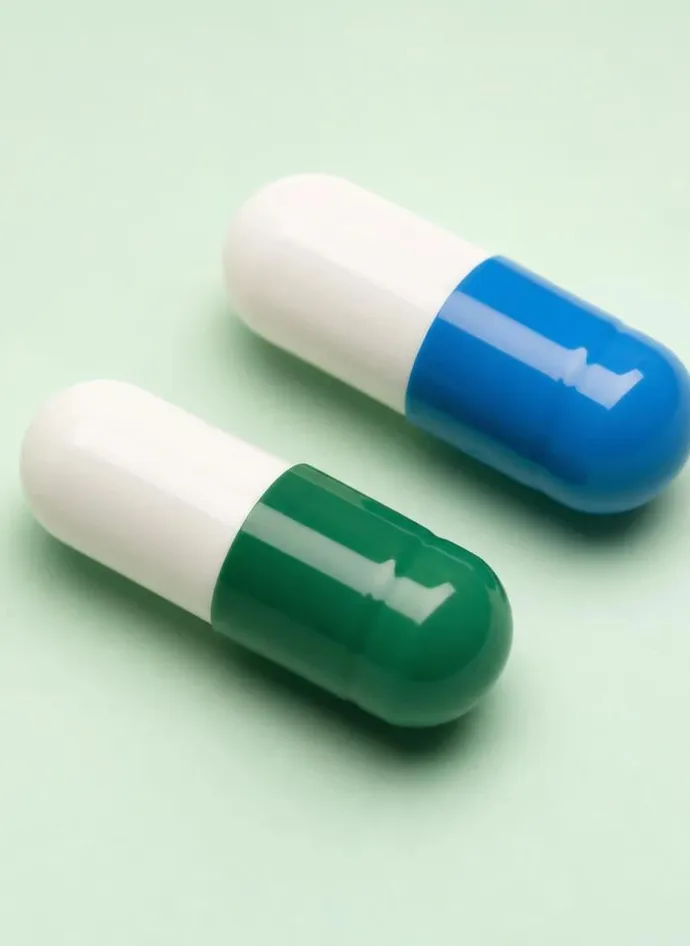
Dicloxacillin
Penicillinase-Resistant Antibiotic for Skin Infections, Abscesses & Staphylococcal Wounds
Dicloxacillin resists the penicillinase enzyme produced by Staphylococcus aureus, making it the first-choice oral antibiotic for skin infections including cellulitis, impetigo, folliculitis, and abscesses.
💊 Available in 250 mg and 500 mg capsules for a complete course of treatment.
👨⚕️ Consult a pharmacist online instantly — no travel, no queues, completely private and convenient.
🚚 Fast, confidential delivery — plain packaging with no product names on the outside, delivered safely to your door.
What is Dicloxacillin?
Dicloxacillin is a penicillin-class antibiotic that targets Staphylococcus aureus, the leading cause of skin infections. It suits shallow skin infections like boils or crusted sores, as well as soft-tissue infections such as cellulitis. It only works against bacteria still sensitive to it, not MRSA, so finish the full course as your pharmacist advises.
🛒 Shop the range above · 24-hour dispatch from Intimo Life — consult a pharmacist if unsure.
Dicloxacillin is a penicillinase-resistant penicillin that kills Staphylococcus aureus — the bacterium responsible for most skin infections including abscesses, cellulitis, impetigo, and infected wounds. It is the preferred oral antibiotic for mild to moderate Staphylococcal skin infections.
Key clinical statistics:
- Clinical cure rates exceed 85% in MSSA skin infections when treatment is completed
- Staphylococcus aureus accounts for over 80% of community-acquired skin infections
- Completing the full 7-10 day course reduces recurrence risk by 3-fold
Dicloxacillin at Intimo Life treats:
- Superficial infections — Impetigo, folliculitis, infected skin wounds
- Soft-tissue infections — Cellulitis, post-injury or post-surgical wound infections
Note: Dicloxacillin does not cover MRSA. Consult a pharmacist before use, especially with penicillin allergy.

Dicloxacillin Antibiotic
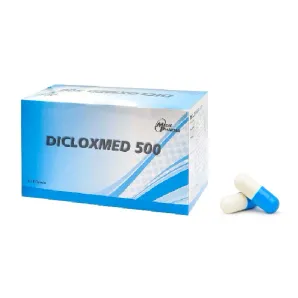 DICLOXMED
Antibiotic for Staph skin infections – take on empty stomach
✓ In stock40.00 ฿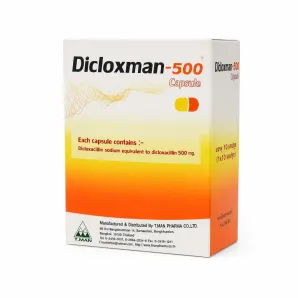 DICLOXMAN-500
Penicillinase-resistant antibiotic for Staph skin infections
✓ In stock48.00 ฿
About Dicloxacillin
What Is Dicloxacillin? How Does It Work?
Dicloxacillin is a penicillinase-resistant penicillin antibiotic that kills bacteria by inhibiting PBP (Penicillin-binding proteins) — enzymes essential for bacterial cell wall synthesis. Without a functional cell wall, bacteria lyse and die.
Its structural resistance to the penicillinase (beta-lactamase) enzyme makes it highly effective against MSSA (Methicillin-susceptible Staphylococcus aureus). It does not cover MRSA or Gram-negative bacteria.
What Infections Does Dicloxacillin Treat?
Dicloxacillin treats infections caused by susceptible Staphylococcus aureus and Streptococcus pyogenes, with a primary focus on skin and soft-tissue infections.
- Impetigo — Blistering and crusting skin infection
- Cellulitis — Skin and subcutaneous tissue infection
- Folliculitis and Furuncle — Infected hair follicles and small abscesses
- Carbuncle — Large multi-follicle abscess
- Infected wounds — Traumatic or post-surgical wounds with Staph contamination
- Hordeolum (stye) — Eyelid Staph infection, used alongside topical eye drops
Dicloxacillin is not appropriate for respiratory, urinary, or bloodstream infections without medical diagnosis.
How to Take Dicloxacillin 500 mg Correctly?
Dicloxacillin must be taken 30-60 minutes before food or 2 hours after eating. Food reduces drug absorption by 30-50%, leaving blood levels too low to treat the infection.
- Adults (mild-moderate): 250-500 mg every 6 hours (4 times daily) for 7-10 days
- Adults (severe infection): 500 mg every 4-6 hours as directed by your doctor
- Children under 40 kg: 12.5-25 mg/kg/day divided every 6 hours (consult a pharmacist)
Complete the full course even if you feel better. Stopping early causes antibiotic resistance. Take with plenty of water and store in a cool, dry place.
What Are the Side Effects of Dicloxacillin?
Dicloxacillin is generally well tolerated, but side effects can occur.
- Common (1-10%): Nausea, vomiting, abdominal pain, diarrhoea — usually mild
- Uncommon (less than 1%): Rash, urticaria, headache
- Stop and seek immediate attention for: Stevens-Johnson syndrome, difficulty breathing, facial or throat swelling (Anaphylaxis), bloody diarrhoea
- Hepatotoxicity (rare): Jaundice, dark urine — discontinue and see a doctor
To reduce gastrointestinal side effects, take a probiotic at least 2 hours apart from the antibiotic.
Dicloxacillin vs Amoxicillin — What Is the Difference?
Both are penicillin-class antibiotics but target very different infections.
- Dicloxacillin — Penicillinase-resistant, for Staphylococcal skin infections (abscesses, cellulitis, impetigo, folliculitis)
- Amoxicillin from our Amoxicillin collection — Broader spectrum, for respiratory infections such as tonsillitis and otitis media
These antibiotics are not interchangeable. Choosing the wrong one promotes antibiotic resistance. Consult a pharmacist to match the antibiotic to your specific infection.
Dicloxacillin and Antibiotic Resistance — Must I Complete the Full Course?
Antibiotic resistance is a global crisis. MRSA — resistant to Dicloxacillin — is now widespread in hospitals and the community.
To help prevent resistance:
- Always complete the full course — Stronger bacteria survive and multiply if you stop early
- Never share antibiotics — Different infections need different antibiotics
- Do not self-prescribe — Consult a pharmacist or doctor first
- Do not use leftover antibiotics — Insufficient stock won't complete a new course
Browse other antibiotics in our Antibiotic collection.
Who Should NOT Take Dicloxacillin? Contraindications?
Dicloxacillin has the following contraindications and precautions:
- Penicillin allergy — Absolute contraindication; risk of life-threatening Anaphylaxis
- Cephalosporin allergy — Cross-reactivity in approximately 1-10%; inform your pharmacist
- Severe liver disease — May accumulate; dose adjustment required under medical supervision
- Pregnancy and breastfeeding — FDA Category B; consult a doctor before use
- Neonates — Consult a paediatrician only
Disclose all current medications before starting — Dicloxacillin may interact with Warfarin and Methotrexate.
⚠️ ข้อจำกัดความรับผิดชอบ
เนื้อหาในบทความนี้มีจุดประสงค์เพื่อให้ความรู้ทั่วไปเท่านั้น ไม่ได้มีเจตนาทดแทนคำแนะนำ การวินิจฉัย หรือการรักษาจากแพทย์หรือเภสัชกรผู้เชี่ยวชาญ หากมีข้อสงสัยเกี่ยวกับอาการหรือการใช้ยา ควรปรึกษาแพทย์หรือเภสัชกรก่อนเสมอ
- Flucloxacillin — Patient Information — NHS
- Dicloxacillin — Drug Information — MedlinePlus (NIH)
- Dicloxacillin — StatPearls — NCBI National Library of Medicine
- Dicloxacillin — Drug Label Information — DailyMed (NIH)
- Essential Medicines List — WHO
Frequently Asked Questions
Always take Dicloxacillin 30-60 minutes before food or 2 hours after a meal. Food reduces drug absorption by 30-50%, leaving blood levels too low to effectively treat the infection. If you miss a dose, take it as soon as you remember — but if the next dose is soon, skip the missed dose and continue the regular schedule. Never double up doses.
The typical course is 7-10 days for mild to moderate skin infections. Symptoms usually improve within 2-3 days, but you must complete the full course even if you feel better. For severe infections or large abscesses, a doctor may prescribe up to 14 days. Never stop early — incomplete courses promote antibiotic resistance. If no improvement within 48-72 hours, consult a pharmacist or doctor.
No — Dicloxacillin belongs to the penicillin class. If you have a documented penicillin allergy, using Dicloxacillin risks severe Anaphylaxis. Inform your pharmacist or doctor immediately so they can prescribe an alternative antibiotic such as Clindamycin or a Macrolide (Azithromycin/Erythromycin) that does not cross-react.
Dicloxacillin is classified as FDA Category B — animal studies show no fetal risk, but there are no well-controlled studies in pregnant women. It may be used when a doctor determines the benefit outweighs the risk. Small amounts pass into breast milk. Always consult your obstetrician or doctor before taking any medication during pregnancy.
Yes — Dicloxacillin treats Hordeolum (stye) caused by Staphylococcus aureus on the eyelid, typically alongside topical antibiotic eye drops such as Chloramphenicol. Warm compress 3-4 times daily helps drainage. If no improvement within 48 hours, see a doctor.
Both belong to the same penicillinase-resistant penicillin class. Dicloxacillin has higher oral bioavailability and achieves approximately 2x higher blood levels than Cloxacillin at equivalent doses. Both treat the same Staphylococcal skin infections effectively.
Yes, children can take Dicloxacillin. For children under 40 kg, the dose is 12.5-25 mg/kg/day divided into 4 doses (every 6 hours). Children over 40 kg use the adult dose (250-500 mg every 6 hours). Consult a pharmacist or paediatrician to calculate the correct dose for your child's weight. For neonates, use must be under direct paediatric supervision only.
You can buy Dicloxacillin at Intimo Life, which offers online pharmacist consultation before purchase to ensure you select the correct antibiotic. Fast delivery in plain packaging with no product names on the outside. We also carry a full range of antibiotics in the Antibiotic collection for different types of bacterial infections.
Become a member of our store to receive news and exclusive discounts.
Recently viewed products